Posted on Leave a comment

Another Myth “Buried”: Islay Walden’s Father

Many years ago, when I first started my research in Randolph County, North Carolina of my mother’s family and the community they came from, I was discussing Islay Walden and his origins with one of the librarians in the Randolph Room at the Randolph County Regional Library. She told me family members believed his father was William D. Walden, a free person of color, whose family also lived in the southern part of Randolph County. She opined that since Islay had been enslaved before emancipation to Gar[d]ners (and Smithermans), it would make sense that after emancipation he would take the surname of his birth father, Walden. Seemed logical.

The family member who had supplied this information was Evie Ruth (Hill) Grady (1925-1998), who descended from Islay’s sister, Sarah (Callicut) Hill. Evie lived in Cincinnati where her great grandparents had moved after they left Randolph County, North Carolina, in the 1890s. I really didn’t research the story in those days (1980s-90s) because I was researching more direct ancestors of my own. Around 2012-13, I began researching Islay Walden and the church and school he began in my ancestors’ community, known today as Strieby Congregational United Church of Christ.

Strieby Congregational United Church of Christ, Asheboro, North Carolina. Photo by Wesley Frennell, 2022

References were found in the American Missionary Magazine, a journal of the American Missionary Association, which was the missionary organization associated with the Congregational Church. It chronicled a number of activities of Islay Walden. However, what caught my attention was his death notice in February 1884. It named his parents as, “Ruth and Branson (Garner) Walden.”[1] Well, Garner was the name of his enslaver when he was born. We knew his mother was Ruth, but who was Branson?


I found two more records that provided additional clues. Neither pointed to William D. William as Islay’s father. The first was a marriage license for a marriage to a Amelia Frances Harriss in Raleigh, NC, that no one had referenced anywhere that I knew. His known wife was Eleanora/Elinora (Farmer) Walden, whom he had met when he was attending the New Brunswick Theological Seminary in New Jersey. So, who was Amelia Frances? Well, that’s a story for another day, but the names of his parents as recorded on his marriage license were Branson and Rutha Walden.[2] Once again, not William.

Marriage License of Alred I(slay) Walden and Amelia Frances Harriss, 17 October 1867, Raleigh, NC

The second was a newspaper interview that appeared in the New York Evening Post the day after he was ordained. The interviewer had asked about his father. He did not name his father but said that his father, who was enslaved, had run away to the Midwest, using false papers.[3] William was still living in Randolph County. A landowner, William had no reason to “run away.” He died in Chatham County, NC, about 1869 and is said to be buried in the William D. Walden Cemetery, in Randolph County, North Carolina.[4]

An Interesting Ordination, Evening Post, 2 July 1879

That Islay was a Walden was not in dispute. After his death, his “cousin,” Henry Ruffin Walden, took over the teaching duties of the school at Strieby. Henry’s father was named Anderson Walden. Their family lived in neighboring Chatham and Moore County. Anderson had died there,[5] but his widow, Julia, and some of their children, including Henry Ruffin had moved to Strieby in the early 1880s. Some stayed in Strieby and were buried in the cemetery there, while others moved up to the town of Asheboro, about 13 miles away.

Henry Ruffin Walden Sr., aon of Anderson and Julia Walden

I had speculated on the exact relationship of Henry and Islay’s fathers in other writings. I reasoned that the William being referenced was not William D, who was contemporary to Anderson and very likely Branson, but an older William, who was not Islay’s father, but Branson’s father. That’s where things stood when I published a biography of Islay Walden in 2021, that included a suggested genealogy in the Appendix.[6]


Recently, Family Search has released a beta program that allows one to do full text searches of unindexed records. I searched on the various names, Islay Walden, Branson Walden, and then Anderson Walden. Bingo. A record popped up of an application to the Eastern Cherokee Claims Commission by Henry Ruffin Walden’s sister. It is irrelevant whether her claim was granted or not, because from a genealogical perspective what matters is the application. Applicants have to give genealogical information in order to try to prove their claim.

Henry’s sister, Margaret (Walden) Lilly, applied in 1906. She was required to name her family: her parents, her siblings, her spouse, her children, and her grandparents and all their children. Predictably, she named her parents as Anderson and Julia Walden (although she listed a different maiden name than the one everyone in her current family members believed). She named all her siblings, her spouse (James Lilly), and her children. Then she named her grandparents. She said her grandfather’s name was John Walden, not William, and her grandmother’s name was Rhoda Garner. [7]

Screenshot
From Margaret Walden Lilly’s 1906 Application to the Eastern Cherokee Claims Commission in the U. S. Court of Claims.

While there is still research needed to confirm which “John” she is referencing (yes there’s more than one candidate), this document went on to answer the question about how Islay, his sister, and Henry, Margaret, and their siblings were related. Margaret stated that John and Rhoda’s children were Anderson, Branson, and Tima who married Brantly Strickland (I had speculated that she was their sister in my own analysis).[8] Thus, Margaret’s information confirmed that she, Henry, their siblings, and Islay, and his sister Sarah, were indeed first cousins.


[1] National Council of the Congregational Churches of the United States (National Council). (1885). The Congregational Year-book (Boston: MA: The Congregational Publishing Society), Volume 7, 37. Retrieved from: 1885 Congregational Year-book

[2] Ancestry.com. North Carolina, U.S., Marriage Records, 1741-2011 [database on-line].  Alfred I. Walden and Amelia Frances Harriss, 17 October 18867, Raleigh, North Carolina. Provo, UT, USA: Ancestry.com Operations, Inc., 2015. Retrieved from: Ancestry.com

[3] An Interesting Ordination. (2 July 1879). Evening Post (New York), n. p.(See also: Margo Lee Williams, From Hill Town to Strieby: Education and the American Missionary Association in the Uwharrie “Back Country” of Randolph County, North Carolina, Crofton, KY: Backintyme Publishing, 2016, 73-74).

[4] Find A Grave Memorial 142492481. William D. “Billy” Walden. Williams D. Walden Cemetery, Cheeks, Randolph County, North Carolina. Retrieved from Findagrave.

[5] National Archives and Records Administration (NARA); Washington, D.C.; Non-population Census Schedules for North Carolina, 1850-1880: Mortality and Manufacturing; Archive Collection: M1805; Archive Roll Number: 3; Census Year: 1869; Census Place: Ritters, Moore, North Carolina; Anderson Walden, October 1869, Page: 496. Retrieved from: Ancestry.com.

[6] Margo Lee Williams. (2021). Born Missionary: The Islay Walden Story (Silver Spring, MD: Margo Lee Williams & Personal Prologue). Appendix.

[7] “United States records,” images, FamilySearch, image 344 of 1378; Margaret Lilly in the Eastern Cherokee Applications of the U.S. Court of Claims. Retrieved from: https://www.familysearch.org/ark:/61903/3:1:3QS7-99WX-42LK?view=fullText

[8] “United States records,” images, FamilySearch, image 344 of 1378; Margaret Lilly in the Eastern Cherokee Applications of the U.S. Court of Claims. Retrieved from: https://www.familysearch.org/ark:/61903/3:1:3QS7-99WX-42LK?view=fullText

Posted on 5 Comments

52 Ancestors: Strieby Church, Randolph County, North Carolina, Family Reunion

Strieby Congregational United Church of Christ in Asheboro, North Carolina, has held Homecoming (Reunion)/Revival services on the fourth Sunday in August, for all of its 144 years so far as we have been able to ascertain. Over the past 10 years we, the descendants of the original community who grew up around the church, established in 1879, have made a concerted effort to preserve, share, and celebrate our history and heritage. Among our accomplishments have been the designation of our site, which originally included a school, as a county Cultural Heritage Site, and a Literary Landmark by United for Libraries (ALA) in honor of our founding minister, Islay Walden, a 19th century African American poet. Our site was also named to the Black Cemetery Network and the Reconstruction-Era National Historic Network.

Our State

Last year, in 2022, our history and Homecoming attracted the attention of North Carolina’s Our State Magazine and writer/editor Mark Kemp. The magazine which chooses a theme for each of its monthly issues, was planning a family reunion theme and wanted to include our story. The extensive story and beautiful pictures were featured in the August 2023 edition. I’ve included some of them here.

Patrice Lassiter Bryant greeting one of her cousins
Strieby Congregational Church, School, and Cemetery Cultural Heritage and Literary Landmark, Strieby Church Road, Asheboro, North Carolina
L-R: Rose Anderson Lassiter, Donnie Simmons Bennett, and Jackcine Simmons Laughlin
Margo Lee Williams holding the original school bell.
Jerry Laughlin receiving a Certificate of Appreciation from his daughter, Tasha Laughlin Hall

Reference

Kemp, M. Wolford, J. & Muthersbaugh, S., photographers. (2023 August). Peace in the Uwharries. Our State Magazine, pp. 116-127.

Posted on 3 Comments

#52 Ancestors – Voting: The 1870 Washington, D. C. Mayoral Election, and Islay Walden

In 1870, Washington, D. C. Mayor Sayles Jenks Bowen[1] was up for re-election. It was a contentious campaign. Bowen was a controversial figure. He was a staunch abolitionist pre-Civil War. He was also a founder of and activist for the Republican Party.

Bowen was elected Mayor of Washington, D. C. in 1868.This was the first time that African Americans could vote in Washington. Their overwhelming support helped Bowen win, despite his minimal support in the European American community. Bowen’s agenda focused on economic and educational opportunity and integration for the newly freed African Americans. Unfortunately, he was so focused on those things that he neglected the basic activities of governing a city. Bowen was so focused on his own agenda that he diverted funds from city services and programs to support job creation for freedmen and school creation for their children. He was impatient with those in the Republican party who would not fully support integrated schools and full employment for the freedmen. He was even willing to invest large sums of his own personal money to augment these efforts. Understandably, he was very popular in the African American community. However, as noted, he neglected other important issues and was draining the city’s financial assets. As the 1870 election approached, many in the Republican Party began to organize along with Democrats against his campaign for re-election.

National Republican, 7 February 1870. Islay Walden’s name highlighted.

On Monday, 7 February 1870, the National Republican reported that the previous Saturday there was a “large meeting at Union League Hall.” The meeting had been advertised in all the local newspapers. The turnout reflected “the large number of citizens favoring reform in the affairs of the Republican party of the city, and who are opposed to the present municipal administration…”[2] According to the article’s sub-titles, there were “Prominent Citizens Present,” and “Old Original Republicans in Council.”  Among those whose names were mentioned as being in attendance was Islay Walden.[3] Islay had only arrived in Washington around January 1868, based on Freedmen’s Bureau records.[4] Was he being considered a “Prominent Citizen?” Prominent enough to be named? Apparently so.

Islay Walden mentioned in a letter to “Mr. Beckley,” Freedmen’s Bureau Records, Washington, D. C., 28 January 1868

One speaker, William H. Brown, Jr., of the Seventh Ward, an area east of the Anacostia River, referred to as being part of “Anacostia,” said that “an effort must be made to induce legislation to protect men in their exercise of the franchise.”[5] He explained that “If a colored man attempts to vote a ticket other than that prepared for him by Corporation Attorney Cook and his satellites, he would be put to flight by a lawless mob.” It was reported that at this point, Islay Walden interrupted the speaker (Brown), asking if there was anyone assaulted other than those “colored men” who were voting for Democrats. Mr. Brown responded that Congress had granted “colored men” the right to vote and therefore their vote was their “with their conscience and their God, and it was not right that they should be disturbed in their rights by a lawless mob.”[6] It would seem from his comment that Islay was loyal to Mayor Bowen and his administration. So, why was he at this meeting? Good question.

Islay Responding to William H. Brown, Jr., National Republican, 7 February 1870

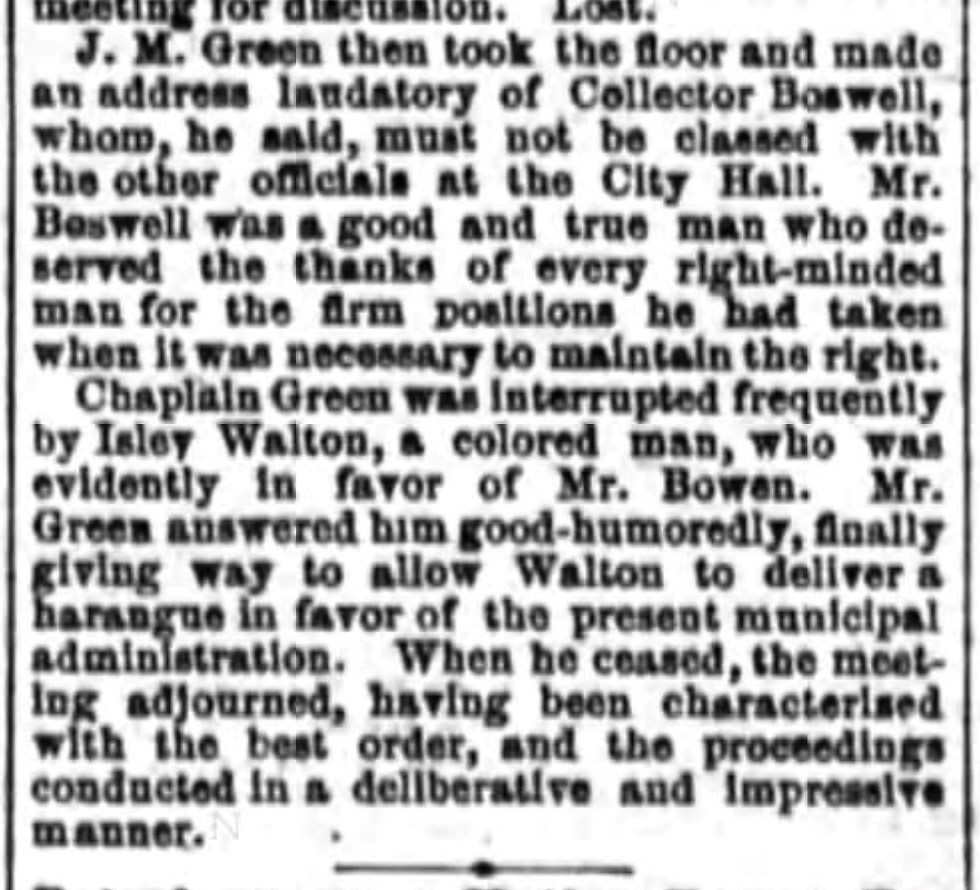
The meeting then went on to discuss and approve a constitution for the new reformed association now being called, “Independent Republican Reform Association.”[7] The meeting went on to discuss the problems that had resulted from Mayor Bowen’s administration. At the end of the evening, a Chaplain J. M. Green spoke. He spoke in support of a Collector Boswell in Mayor Bowen’s administration. The reporter for the National Republican noted that Chaplain Green was “interrupted frequently by Isley Walton [sic], a colored man, who was evidently in favor of Mr. Bowen.”[8] Apparently, Chaplain Green was not angered by the interruption but did grow frustrated as he “answered him good naturedly, finally giving way to allow Walton to deliver a harangue in favor of the present municipal administration.”[9] Chaplain Green may not have been distressed by Islay’s interruptions, but it appears that others had heard enough since the meeting adjourned after Islay finished speaking. Nevertheless, the meeting was “characterized with the best order, and the proceedings conducted in a deliberative and impressive manner.”[10]

Islay Walden speaking at Republican association meeting, National Republican, 7 February 1870

Mayor Sayles Jenks Bowen was defeated in 1870 by his Democratic opponent, Matthew Gault Emery.

There have been other hints at Islay’s interest in the political landscape of his time. Not long after arriving in Washington, D. C., in 1868, he went to Philadelphia to attend the Republican Convention, where General Grant was nominated the Presidential candidate for that year. He talked about that trip in the introduction to, and in, his poem, “Ode to Mr. Dunlap and Family.”[11]

1870 would have additional significance for Islay. That was year the Fifteenth Amendment was passed. Celebrations were held in Washington and around the country on 2 April 1870. Islay didn’t write a specific poem about his attendance of those celebrations. Rather, he references his presence in poems that address events around those celebrations. One poem he dedicated to a young girl, Clara Saunders, who helped him cross the street.[12] The other referenced Charles Sumner’s speech at that celebration.[13]

After reading about Islay’s assertiveness at the Republican meeting above, one cannot be surprised that Islay managed to have a personal meeting with President Ulysses Grant. In a letter to his niece, Catherine Hill, Islay mentioned that he had met the President, who encouraged him to never give up trying to get the education he sought. Islay added that he gave the President one of his poems.[14] It would be wonderful if the poem was preserved somewhere among Grant’s papers in the Presidential Library on the campus of Mississippi State University.

Islay’s political boldness continued as years went by. By 1883, he had returned to his home community in Randolph County, North Carolina. There, he founded a church and school, then known as Promised Land Church and a school, called Promised Land Academy. Islay had long been an advocate for temperance and apparently was a strong advocate in his community, even doing so before the North Carolina General Assembly. In March 1883, Islay was able to convince the General Assembly to pass “an Act to prohibit the sale of spirituous liquors within one (1) mile of the Promised Land Academy in New Hope Township, …”[15]

It is apparent that Islay Walden, who was a talented missionary and poet, was also a gifted politician. Sadly, he died at age 40, in February 1884, only a year after his victory in the General Assembly. I can’t help but wonder what he would have accomplished had he not died so young.

Islay Walden Death Notice in Alamance Gleaner, 28 February 1884, “gleaned” from Ashboro Courier.

Although Promised Land Academy is long gone, after serving the community’s children for over forty years, including my maternal ancestors, the church has continued to serve those in the community and descendants of the founding families, for 142 years, this past October (2021). In 2014, the church site, now known as “Strieby Congregational UCC Church,” became a Randolph County Cultural Heritage Site, and in 2021, was named a United for Libraries Literary Landmark.

[1] Tindall, William, “A Sketch of Mayor Sayles J. Bowen,” Records of the Columbia Historical Society, Washington, D.C., Vol. 18 (1915), pp. 25-43 Retrieved from: JSTOR.org

[2] “Reform: Large Meeting at Union League Hall,” National Republican, February 7, 1870, p. 4. Retrieved from: Newspapers.com.

[3]Ibid.

[4] Islay Walden, in Letter to Mr. Beckley, January 20, 1868, Records of the Field Offices for the District of Columbia, Bureau of Refugees, Freedmen, and Abandoned Lands, 1865-1870; NARA M1902, Roll 19. Retrieved from: Ancestry.com

[5]Op cit.

[6]Ibid.

[7]Ibid.

[8] Ibid.

[9]Ibid.

[10] Ibid.

[11] Williams, Margo Lee, Born Missionary: The Islay Walden Story, (Silver Spring, MD: Margo Lee Williams, Personal Prologue), 2021, pp. 23-25.

[12]Ibid, p. 28.

[13]Ibid, pp. 29-31.

[14]Ibid, p. 26.

[1]Ibid, p. 77.