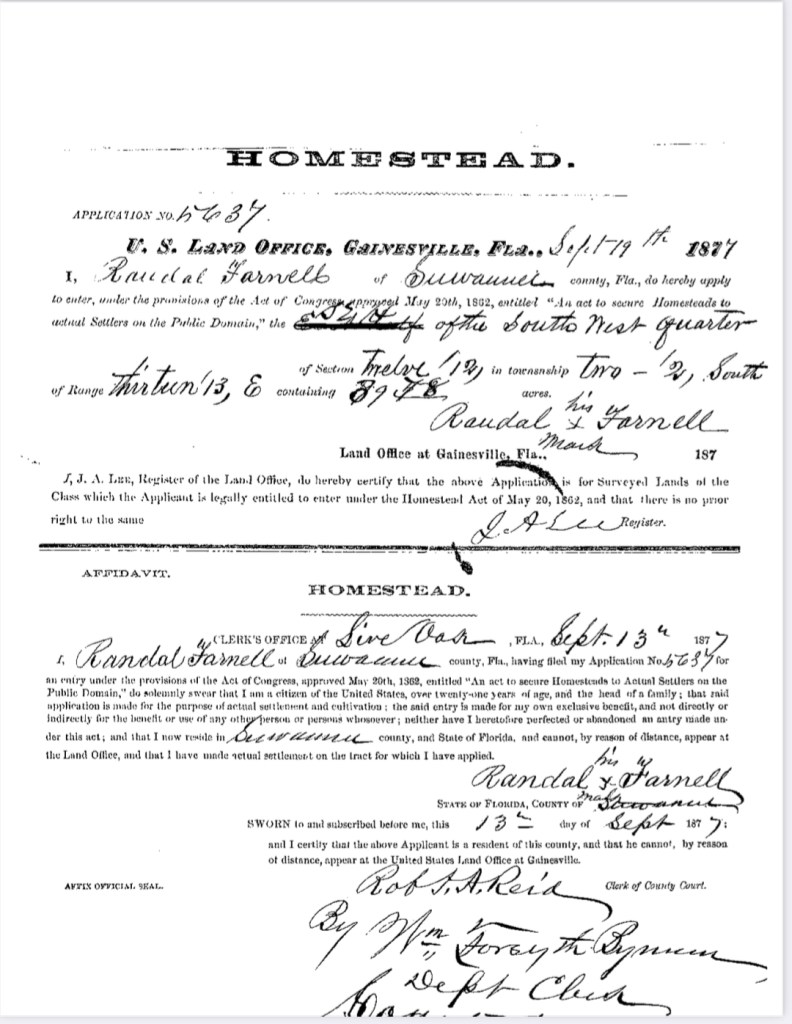
In truth, I don’t know a lot about the men in my great grandfather’s (Randel Farnell) community who filed applications for land in the 1870s and ‘80s, under the Homestead Act of 1862. Until recently, I did not realize how many of his neighbors and potential friends had filed for claims under the Homestead Act. I especially did not realize how many Black neighbors had filed claims. Neither the Bureau of Land Management (BLM) index nor the records themselves have any identifying information concerning race. Therefore, one must research each name (unless one is already familiar with a particular individual) in other records to determine their racial identity. I learned their identities, and the identities of others in other sections of Suwannee County by checking each name against the census. In Section 12, I found two other men of color, besides my great grandfather and one of his witnesses (Henry McGehee/McGhee/McGee) whose daughter would marry my great grandmother’s brother. Across the county I found over 40.
Indeed, Suwannee County was by no means unique in having claimants of color. There were Black claimants throughout Florida, Alabama, Mississippi, Louisiana, and Arkansas. Stories about some of these settlers by their descendants (including three of mine) are told in the new book, Black Homesteaders of the South (History Press, 2022), to be released in October 2022.[1]

Black Claimants and Witnesses in Section 12
As noted, initial information stemmed from my great grandfather, Randel Farnell, and his claim. From his paperwork, I realized one of his witnesses was Henry McGehee/McGhee/McGee, who was the father of Addie McGhee, who married my great grandmother Sallie Jacobs Farnell’s younger brother Joseph. I noticed from their applications, that their properties were adjacent to each other. Conversely, my great grandfather, Randel, had been a witness on Henry’s application. In fact, Henry’s application predated my great grandfather’s. I have already written about these two applications in previous posts, but what about the other Black Homesteaders in Section 12? Were they also possibly good friends? Certainly, they must have known each other.
Ned Wilson[2]
Edward “Ned” Wilson reported in 1880 that he was born in Georgia about 1840.[3] He appeared first in Suwannee County records when he registers to vote on 6 August 1867, as recorded in Voter Registration Book 1, p. 196.[4] He reported having been in the state for twelve months previously. There is no record found to date for his marriage to “Ida,” his wife on the 1880 census.[5] She apparently died before 1885, when Edward/Ned was listed as unmarried. At that time, Edward was living with my great grandfather, Randel Farnell (also a homesteader), and his family, and next door to Henry McGehee.[6] On 6 December 1903, there was a marriage record for an Edward Wilson and Mary Blalock.[7] There is no way to ascertain if this is the same Edward Wilson since no other evidence of his residence at that time in Live Oak has been identified. There is no known information about when or where he died.
[1885 census with Randel next to Henry]

On 21 May 1869, Edward Wilson appeared before the Registrar, Charles Mundee, at the Land Office in Tallahassee, Florida. There he made application under the Homestead Act of 1862 for 39.89 acres in the SE ¼ of the SE ¼ of Section 12 of Range 13E, Township 2S. He paid $7.00 for the application.
Seven years later, on 16 May 1879, William Forsyth Bynum and Isreal [sic] Samuel Whitehurst Sr. provided testimony for Edward’s final proof for his Homestead application. This record does not show whether the witness was William Forsyth Sr. or Jr. William Jr. was closer in age to Isreal Whitehurst, but William Sr. was closer in age to Edward. However, William Sr. was Deputy Clerk of the Circuit Court. He was also a witness along with my great grandfather, Randel Farnell, for homesteader and neighbor, Henry McGehee.

William Forsyth Bynum Sr. was born in Virginia, but moved to Dooly County, Georgia, where he married his wife, Elsie Ann Posey.[8] They had three sons, William Jr., John, and Francis.[9] William, and family, moved to Florida. He was listed as a “druggist” and “farmer,” in the 1870[10] and 1880[11] censuses respectively. During the Civil War he served in the Confederate 4th Florida Infantry.[12] William died in 1904, in Live Oak, and is buried in Antioch Baptist Church Cemetery.[13] William’s son, John, filed for his own Homestead land in 1892, in the same quadrant as Randel Farnell, Henry McGee, and Edward Wilson.[14]
Isreal Samuel Whitehurst Sr. was born reportedly in Florida.[15] He was married to Chloe Eliza McKinney.[16] They had fourteen children. Isreal, Edward, and my great grandfather, Randel Farnell, were friends. At least two of Isreal’s daughters, Rebecca and Senter, attended the Florida Normal and Industrial College in Tallahassee (now, Florida A & M University) with my grandmother, Randel’s daughter, Lela, as evidenced by their entries in my grandmother’s autograph book.[17]

Isreal died in 1921 and was buried in Eastside Memorial Cemetery, in Live Oak.[18]
William Bynum and Isreal Whitehurst stated in their testimony that Edward was the head of a family that included a wife and child (no child was listed in the 1880 census), and that he settled on his land on 21 May 1869. They said he cleared and fenced “16 or 18” acres. They went on to state that he had planted 300 fruit trees and cultivated the land yearly. They went on to state that Edward began living on the land permanently around “August or September” 1869. For the home portion of the land, they said he had fenced and cultivated 4-18 acres of land on which he had, “built a house with two rooms, corn crib, chicken house, planted and cultivated almost 300 fruit trees, and now in good repair and in cultivation.” They said they were swearing to this at the local circuit courthouse because of the distance to the land office now located in Gainesville. The final receipt of payment of $2.00, for the recording of the patent was noted as received “by RR” by the land office in Gainesville, on 19 May 1876. A final Certificate #1058 was issued on 19 March 1877. The Patent was sent to the Recorder on 22 May 1877. It was recorded on 15 June 1877, in Book 2, page 395, of the federal land records. The Patent was forwarded to the Live Oak Registrar of Deeds on 7 October 1880, however, there is no record of its recordation in the Suwannee County Deed Index, nor of its sale at any future date.

As mentioned above, where or when Edward Wilson died is unknown.
Shadrack Taylor[19]
Shadrack Taylor and his wife, Jane, were both reportedly born in Georgia about 1827 and 1828, respectively.[20] Shadrack states in the 1880 census that his father was from the District of Columbia, but his mother was from Spain. Exactly how and when Shadrack and Jane came to Florida is not known. However, he was in Suwannee County by 12 October 1866, when he filed Application 209 with the land office in Tallahassee, for the North half of the Southeast Quarter of Section 12, Township 2S, of Range 13, equaling 39.89. acres of land.

Shadrack and his wife appeared in the 1880 census, [21] living next door to my great grandfather, Randel Farnell, also a Black Florida Homesteader.[22] However, he does not appear in the federal census again, not even in the 1885 state census was he found. What happened to him? Where was Jane? The Homestead file gave some answers.

According to an affidavit on 22 July 1884, made by Jane Taylor, Shadrack’s wife, he died in October 1883. She stated that they had been living on the land when he filed for the application in 1866. She stated that they had built a house, fenced the land, cleared, and cultivated it, living continuously on the land until Shadrack’s death. She went on to state that she had continued to live on the land after his death until the present. However, she states that due to his “illiteracy” and his “ignorance of the law,” he had failed to “prove up” and make “final proof,” of his “continuous occupation and cultivation of his said homestead within the “statutory period.” Therefore, the claim had been cancelled on 13 March 1876.

Subsequently, Jane went on to attest that on 22 April 1879, “May Rigon” made Application 7148, on the same land as Shadrack Taylor’s. Jane stated that May Rigon had not lived one single day on the property and that she had, in fact, left the state of Florida shortly after filing and resided in Georgia ever since. Jane said, on the other hand, that she has continuously resided on the land that noted in her husband’s Application 209. Therefore, she was requesting that May Rigon’s application be set aside in favor of Shadrack’s, and that she, Jane, as his widow, be allowed to make final proof, thereby completing the application. She was represented by John Bynum, son of William Forsyth Bynum,[23] Deputy Clerk of the Court and a witness for Black Homesteader Henry McGehee. On the same day, that Jane Taylor testified, Elijah Smith (a Black Homesteader in Section 2, not 12)[24] and Edward “Ned” Wilson (another Black Homesteader in Section 12[25]) gave testimony on Jane’s behalf. They testified that everything she had said was true.

Alas, Jane would not live much longer on the property. By October 1884, she too had died. The probate Judge, R. W. Phillips, certified on 8 February 1886, that Adelice Goldwire was one of the heirs of Shadrack Taylor. However, that same day, Adelice testified that she was unable to produce the Receiver’s receipt for Shadrack’s Application 209. Nothing more is known about Adelice.

On 17 February 1886, a receipt for $97.73 was issued to the “Heirs of Shadrack Taylor,” who lived in Valdosta, Lowndes County, Georgia, for Application 11102, for 79.73 acres described as the North ½ of the SE ¼ of Section 12. It is notable that this is the same description for Shadrack’s parcel, but his application said the property was 39 acres, while this application said it was 79 acres. A patent was finally issued on 26 June 1889. However, the patent was not registered with the Suwannee County Registrar of Deeds until 29 June 1909.[26]

It is not known where either Shadrack or Jane Taylor were buried.
The FAN Club
We talk a lot about the “FAN Club” in genealogy. It is a term coined by the renowned genealogist, Elizabeth Shown Mills. It refers to “Friends, Associates, and Neighbors,” in other words, our social circle. We readily look for them in census records, but we don’t often look in other records. We do recognize that witnesses on our family deeds and wills are frequently family members, friends, and neighbors, but we don’t look often enough to see if our ancestors were witnesses for their neighbors. Even so, the most information we usually glean is that our ancestor signed the specific document. Here we have not only signatures but testimonies about the claimants, and some information about how long the claimants and witnesses have known each other. These documents helped paint a picture of at least a part of my great grandfather Randel Farnell’s social circle, his FAN club, to wit:
Randel and William Bynum were witnesses for Henry McGehee, whose daughter married my great grandfather’s brother in-law. Henry McGehee was witness for my great grandfather. Isreal Whitehurst, a friend of my great grandfather’s, whose daughters went to school with my grandmother, was witness for Ned Wilson, who lived with my great grandfather in 1885. Ned Wilson was a witness on behalf of Jane, the widow of Shadrack Taylor, who lived next door to my great grandfather and Henry McGehee in 1880.
In addition, in the case of Shadrack, we also have information about his death, his heirs, and where the heirs lived. These records really are a treasure trove of information. Thus, by studying the documents of our ancestors’ witnesses, we get a glimpse into their world, not just their lives.
References
[1] Bennett, B. A., Black Homesteaders of the South (Cheltenham, UK: The History Press); to be released 24 October 2022 (available for pre-order).
[2] Publication of this essay by the National Park Service on its Black Homesteading website is pending. See also: Edward Wilson, Accession #FL0680__.395, General Land Office Records, Bureau of Land Management. Retrieved from: BLM General Land Office Records.
[3] 1880 US Federal Census, Precinct 1, Suwannee County, Florida; Head: Ned Wilson, NARA Roll: 132; Page: 281A; Enumeration District: 145. Retrieved from Ancestry.com.
[4] Voter Registration Rolls, 1867-68. Tallahassee, Florida, USA: Florida Memory, State Library & Archives of Florida. Floridamemory.com
[5] Supra 3, Ida Wilson, wife.
[6] Florida, U.S., State Census, 1885 [database on-line], Head: Ned Wilson. Provo, UT, USA: Ancestry.com Operations Inc, 2005. Retrieved from: Ancestry.com.
[7] Florida, U.S., County Marriage Records, 1823-1982 [database on-line] Edward Wilson and Mary Blalock, 26 December 1903. Lehi, UT, USA: Ancestry.com Operations, Inc., 2016. Retrieved from: Ancestry.com.
[8] Georgia, U.S., Marriage Records from Select Counties, 1828-1978 [database on-line], William F. Bynum and Ann Posey. Provo, UT, USA: Ancestry.com Operations, Inc., 2013. Retrieved from: Ancestry.com.
[9] 1870 US Federal Census: Subdivision 9, Suwannee County, Florida; Head: William F. Bynum, NARA Roll: M593_133; Page: 693A. Retrieved from: Ancestry.com.
[10] 1870 US Federal Census: Subdivision 9, Suwannee County, Florida; Head: William F. Bynum, NARA Roll: M593_133; Page: 693A. Retrieved from: Ancestry.com.
[11] 1880 US Federal Census: Precinct 1, Suwannee County, Florida; Head: William F. Bynum, NARA Roll: 132; Page: 293A; Enumeration District: 145. Retrieved from: Ancestry.com.
[12] U.S., Confederate Soldiers Compiled Service Records, 1861-1865 [database on-line], William F. Bynum. Provo, UT, USA: Ancestry.com Operations, Inc., 2011. Retrieved from: Ancestry.com.
[13] Find a Grave, database and images, memorial page for Dr William Forsyth Bynum (29 Feb 1832–9 May 1904), Find a Grave Memorial ID 57928601, citing Antioch Baptist Church Cemetery, Live Oak, Suwannee County, Florida, USA ; Maintained by KChaffeeB (contributor 46506715) . Retrieved from: Findagrave.com
[14] Bureau of Land Management. Florida, U.S., Homestead and Cash Entry Patents, [database on-line], John H. Bynum, Application 16601, Patent 9442. Retrieved from: BLM General Land Office Records.
[15] 1880 US Federal Census: Precinct 1, Suwannee County, Florida; Isreal Whitehurst, Head. NARA Roll: T9-132; Page: 285A; Enumeration District: 145. Retrieved from: Ancestry.com.
[16] 1900 US Federal Census: Live Oak, Suwannee County, Florida; Isrial Whites [sic], head; Chloey, wife; married 35 years (circa 1885). NARA Roll: T623-177; Page: 18; Enumeration District: 0109; FHL microfilm: 1240177. Retrieved from: Ancestry.com.
[17] Williams, M. A., “Autograph Book of Lela Virginia Farnell,” Journal of the Afro American Historical and Genealogical Society, Volume 16, Number 2 (1997). Original in the Farnell-Williams Collection at the Meeks-Eaton Black Archives, Florida A & M University.
[18] U.S., Find a Grave Index, 1600s-Current [database on-line]. Isreal S. Whitehurst, Eastside Memorial Cemetery, Live Oak, Suwannee County, Florida; Memorial #187212592; Lehi, UT, USA: Ancestry.com Operations, Inc., 2012. Retrieved from: Ancestry.com
[19] This essay is pending publication on the National Park Service’s Black Homesteading website. See also: Shadrack Taylor, Accession #FL0630__.293, General Land Office Records, Bureau of Land Management. Retrieved from: BLM General Land Office Records.
[20] 1880 US Federal Census: Precinct 1, Suwannee County, Florida, Shadrick Taylor, head; Jane Taylor, wife. NARA Roll: 132; Page: 282C; Enumeration District: 145. Retrieved from: Ancestry.com.
[21] Ibid.
[22] Ancestry.com. U.S., General Land Office Records, 1776-2015 [database on-line], Randel Farnell. Provo, UT, USA: Ancestry.com Operations Inc, 2008. Retrieved from Ancestry.com.
[23] 1860 US Federal Census, Township 5, Lafayette County, Florida, Wm F. Bynum, head; John Bynum, age 3; NARA Roll: M653_107; Page: 965; Family History Library Film: 803107. Retrieved from Ancestry.com.
[24] Bureau of Land Management. Florida Pre-1908 Homestead & Cash Entry Patents, Elijah Smith, Accession Number FLO760_.460. General Land Office Automated Records Project, 1993. Retrieved from: BLM General Land Office Records.
[25] Grantee Index to Deeds, Suwannee County Florida, Heirs of Shadrack Taylor from United States of America, Homestead Certificate, (29 July 1909, Deed Book GG, p. 380) p. 104, Image 661. Retrieved from: FamilySearch.org.
[26] Bureau of Land Management. Florida, U.S., Homestead and Cash Entry Patents, Pre-1908 [database on-line], Edward Wilson. Provo, UT, USA: Ancestry.com Operations Inc, 1997. Retrieved from: Ancestry.com.