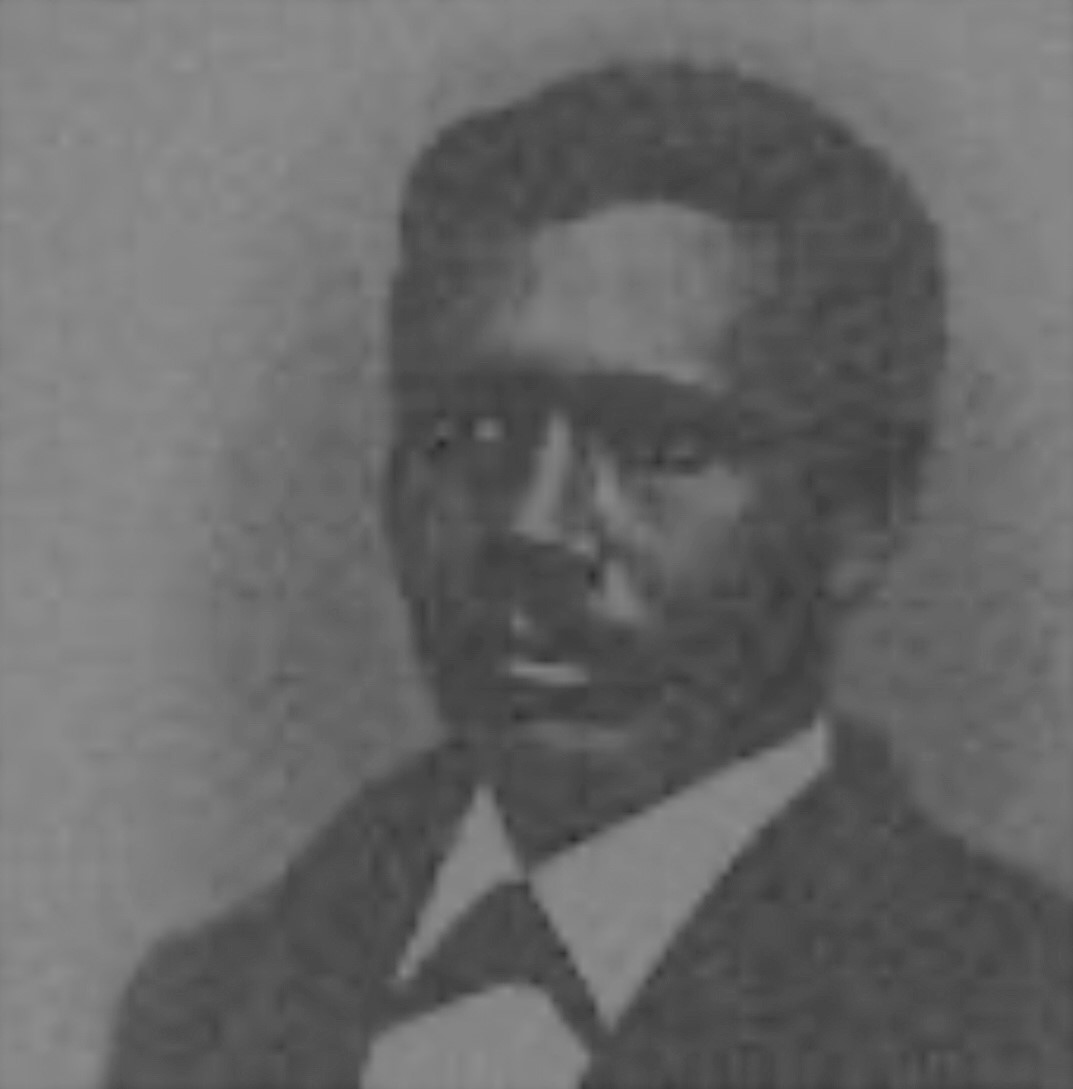
Many years ago, when I first started my research in Randolph County, North Carolina of my mother’s family and the community they came from, I was discussing Islay Walden and his origins with one of the librarians in the Randolph Room at the Randolph County Regional Library. She told me family members believed his father was William D. Walden, a free person of color, whose family also lived in the southern part of Randolph County. She opined that since Islay had been enslaved before emancipation to Gar[d]ners (and Smithermans), it would make sense that after emancipation he would take the surname of his birth father, Walden. Seemed logical.
The family member who had supplied this information was Evie Ruth (Hill) Grady (1925-1998), who descended from Islay’s sister, Sarah (Callicut) Hill. Evie lived in Cincinnati where her great grandparents had moved after they left Randolph County, North Carolina, in the 1890s. I really didn’t research the story in those days (1980s-90s) because I was researching more direct ancestors of my own. Around 2012-13, I began researching Islay Walden and the church and school he began in my ancestors’ community, known today as Strieby Congregational United Church of Christ.
Strieby Congregational United Church of Christ, Asheboro, North Carolina. Photo by Wesley Frennell, 2022
References were found in the American Missionary Magazine, a journal of the American Missionary Association, which was the missionary organization associated with the Congregational Church. It chronicled a number of activities of Islay Walden. However, what caught my attention was his death notice in February 1884. It named his parents as, “Ruth and Branson (Garner) Walden.”[1] Well, Garner was the name of his enslaver when he was born. We knew his mother was Ruth, but who was Branson?
I found two more records that provided additional clues. Neither pointed to William D. William as Islay’s father. The first was a marriage license for a marriage to a Amelia Frances Harriss in Raleigh, NC, that no one had referenced anywhere that I knew. His known wife was Eleanora/Elinora (Farmer) Walden, whom he had met when he was attending the New Brunswick Theological Seminary in New Jersey. So, who was Amelia Frances? Well, that’s a story for another day, but the names of his parents as recorded on his marriage license were Branson and Rutha Walden.[2] Once again, not William.
Marriage License of Alred I(slay) Walden and Amelia Frances Harriss, 17 October 1867, Raleigh, NC
The second was a newspaper interview that appeared in the New York Evening Post the day after he was ordained. The interviewer had asked about his father. He did not name his father but said that his father, who was enslaved, had run away to the Midwest, using false papers.[3] William was still living in Randolph County. A landowner, William had no reason to “run away.” He died in Chatham County, NC, about 1869 and is said to be buried in the William D. Walden Cemetery, in Randolph County, North Carolina.[4]
An Interesting Ordination, Evening Post, 2 July 1879
That Islay was a Walden was not in dispute. After his death, his “cousin,” Henry Ruffin Walden, took over the teaching duties of the school at Strieby. Henry’s father was named Anderson Walden. Their family lived in neighboring Chatham and Moore County. Anderson had died there,[5] but his widow, Julia, and some of their children, including Henry Ruffin had moved to Strieby in the early 1880s. Some stayed in Strieby and were buried in the cemetery there, while others moved up to the town of Asheboro, about 13 miles away.
Henry Ruffin Walden Sr., aon of Anderson and Julia Walden
I had speculated on the exact relationship of Henry and Islay’s fathers in other writings. I reasoned that the William being referenced was not William D, who was contemporary to Anderson and very likely Branson, but an older William, who was not Islay’s father, but Branson’s father. That’s where things stood when I published a biography of Islay Walden in 2021, that included a suggested genealogy in the Appendix.[6]
Recently, Family Search has released a beta program that allows one to do full text searches of unindexed records. I searched on the various names, Islay Walden, Branson Walden, and then Anderson Walden. Bingo. A record popped up of an application to the Eastern Cherokee Claims Commission by Henry Ruffin Walden’s sister. It is irrelevant whether her claim was granted or not, because from a genealogical perspective what matters is the application. Applicants have to give genealogical information in order to try to prove their claim.
Henry’s sister, Margaret (Walden) Lilly, applied in 1906. She was required to name her family: her parents, her siblings, her spouse, her children, and her grandparents and all their children. Predictably, she named her parents as Anderson and Julia Walden (although she listed a different maiden name than the one everyone in her current family members believed). She named all her siblings, her spouse (James Lilly), and her children. Then she named her grandparents. She said her grandfather’s name was John Walden, not William, and her grandmother’s name was Rhoda Garner. [7]
From Margaret Walden Lilly’s 1906 Application to the Eastern Cherokee Claims Commission in the U. S. Court of Claims.
While there is still research needed to confirm which “John” she is referencing (yes there’s more than one candidate), this document went on to answer the question about how Islay, his sister, and Henry, Margaret, and their siblings were related. Margaret stated that John and Rhoda’s children were Anderson, Branson, and Tima who married Brantly Strickland (I had speculated that she was their sister in my own analysis).[8] Thus, Margaret’s information confirmed that she, Henry, their siblings, and Islay, and his sister Sarah, were indeed first cousins.
[1] National Council of the Congregational Churches of the United States (National Council). (1885). The Congregational Year-book (Boston: MA: The Congregational Publishing Society), Volume 7, 37. Retrieved from: 1885 Congregational Year-book
[2] Ancestry.com. North Carolina, U.S., Marriage Records, 1741-2011 [database on-line]. Alfred I. Walden and Amelia Frances Harriss, 17 October 18867, Raleigh, North Carolina. Provo, UT, USA: Ancestry.com Operations, Inc., 2015. Retrieved from: Ancestry.com
[3] An Interesting Ordination. (2 July 1879). Evening Post (New York), n. p.(See also: Margo Lee Williams, From Hill Town to Strieby: Education and the American Missionary Association in the Uwharrie “Back Country” of Randolph County, North Carolina, Crofton, KY: Backintyme Publishing, 2016, 73-74).
[4] Find A Grave Memorial 142492481. William D. “Billy” Walden. Williams D. Walden Cemetery, Cheeks, Randolph County, North Carolina. Retrieved from Findagrave.
[5] National Archives and Records Administration (NARA); Washington, D.C.; Non-population Census Schedules for North Carolina, 1850-1880: Mortality and Manufacturing; Archive Collection: M1805; Archive Roll Number: 3; Census Year: 1869; Census Place: Ritters, Moore, North Carolina; Anderson Walden, October 1869, Page: 496. Retrieved from: Ancestry.com.
[6] Margo Lee Williams. (2021). Born Missionary: The Islay Walden Story (Silver Spring, MD: Margo Lee Williams & Personal Prologue). Appendix.
Strieby Congregational United Church of Christ in Asheboro, North Carolina, has held Homecoming (Reunion)/Revival services on the fourth Sunday in August, for all of its 144 years so far as we have been able to ascertain. Over the past 10 years we, the descendants of the original community who grew up around the church, established in 1879, have made a concerted effort to preserve, share, and celebrate our history and heritage. Among our accomplishments have been the designation of our site, which originally included a school, as a county Cultural Heritage Site, and a Literary Landmark by United for Libraries (ALA) in honor of our founding minister, Islay Walden, a 19th century African American poet. Our site was also named to the Black Cemetery Network and the Reconstruction-Era National Historic Network.
Our State
Last year, in 2022, our history and Homecoming attracted the attention of North Carolina’s Our State Magazine and writer/editor Mark Kemp. The magazine which chooses a theme for each of its monthly issues, was planning a family reunion theme and wanted to include our story. The extensive story and beautiful pictures were featured in the August 2023 edition. I’ve included some of them here.
Patrice Lassiter Bryant greeting one of her cousins
Strieby Congregational Church, School, and Cemetery Cultural Heritage and Literary Landmark, Strieby Church Road, Asheboro, North Carolina
L-R: Rose Anderson Lassiter, Donnie Simmons Bennett, and Jackcine Simmons Laughlin
Margo Lee Williams holding the original school bell.
Jerry Laughlin receiving a Certificate of Appreciation from his daughter, Tasha Laughlin Hall
Reference
Kemp, M. Wolford, J. & Muthersbaugh, S., photographers. (2023 August). Peace in the Uwharries. Our State Magazine, pp. 116-127.
The 28-30 August (2023) will be the 161st anniversary of the Second Battle of Manasses. About a year ago I learned that Strieby (Randolph County, NC) community member Calvin Hill may have been there. I wanted to know more.
Calvin Hill
Calvin Hill was one of the twelve children of Ned and Priscilla Hill, Free People of Color, who lived in Hill Town, subsequently named Strieby, in what is now Union Township in southwestern Randolph County, North Carolina.[1] Calvin was born about 1838 and died on 28 October 1909.[2] He was married to Elizabeth Chandler, daughter of Violet Chandler. They had seven children.[3]
The Arthur Hill Interview
Calvin’s grandson, Arthur Hill, was born in 1887 and lived his whole life in the Strieby community, dying in 1980. His house still stands and is the last original home of the Strieby community of color (there are still homes owned by white residents). Over the years, Arthur was interviewed several times for newspaper stories about the unique history of Strieby. In 1978, he was interviewed by Robert Stephens. The entire interview can be found in DigitalNC.[4]
Arthur Hill in front of his house in Strieby, believed taken in 1978 as part of the Stephens interview. Photo courtesy of his granddaughter, Christine Hill.
Much of the interview covered his childhood experiences, but there were also questions about his family and the Civil War years. It was that part of the interview that revealed the experiences of Calvin Hill, which have been heretofore unknown, even to living family members. When Arthur was asked if any of his family fought in the Civil War, he responded that his grandfather was drafted and served as a cook for the South, not a soldier, and he helped care for the horses. However, the comment that caught my attention instantly was, “And about that time, they called the Battle of Manasses.”[5] I wanted to know what CSA regiment from Randolph County was at the Battle of Manasses? “First or Second?” a friend asked
Hill Town (Strieby) was in the Uwharrie Mountains, now the Uwharrie National Forest, near the Uwharrie River. Not surprisingly, a CSA regiment was raised from that area that was nicknamed “the Uwharrie Boys.”[6] It seemed likely that this was the unit to which Calvin was attached. But were they at the Battle of Manasses, either one or two? Another piece of information Arthur included was that his grandfather told him that a general was injured and died. Calvin was also injured when he was shot through his canteen. Arthur added that Calvin remained with the regiment until the end of the war. So, what do we know about the Uwharrie Boys?
The Uwharrie Boys
Company H, 38th Regiment, CSA, was under the command of Captain Noah Rush and Captain William L. Thornburg and was known as “the Uwharrie Boys.” After looking up the battle/campaign history of the 38th Regiment, I was shocked to learn that the 38th Regiment participated in nearly every significant battle of the war, including Gettysburg, Sharpsburg, and Petersburg to name a few. Even more surprising, they were at Appomattox Court House when General Lee surrendered to General Grant. In other words, Calvin likely had a bird’s eye view of some of the most significant military events of the Civil War, culminating in the surrender.[7]
So, what about Arthur’s memory of what he was told about the Battle of Manasses by his grandfather? If Calvin was with the Uwharrie Boys, then Arthur was right, his grandfather was there, at the second Battle.
Battle of Manasses Recollections
In 1901, Lt. Col. George W. Flowers wrote a history of the 38th Regiment, including the Battle of Manasses.
“…On August 28th, the command formed a line of battle for the memorable second battle of Manassas, which was a series of battles for three days. Brig. Gen. Pender’s Brigade (the 38th) took possession of the bridge across Bull Run and engaged the enemy across the river. His brigade finally crossed over to the east side, but the enemy withdrew. The loss was very slight. On Friday, August 29th, the enemy changed position and was attempting to interpose his army between Maj. Gen. Jackson and the town of Alexandria.”[8]
Brig. Gen. William D. Pender’s (NC) Report
“Finally, …. I ordered my brigade forward, … My men advanced well, receiving grape from the batteries; but support being waited for in vain, and seeing columns on my left and right manoeuvering [sic] to flank me, I withdrew and marched back to the railroad cut, a little to the right of the position previously held by General Gregg. [9]
“General Archer very kindly came forward and relieved me until I could march to the rear and rest my men. I was ordered to the right to support some one of General Jackson’s brigades. … We advanced steadily, driving the enemy from the field through the woods. … We continued our advance until after dark, when we came in contact with a body of the enemy. Each fired a volley. They ran and we rested for the night. Thus ended the Manassas fight with me. The brigade, with the exception of a few skulkers, behaved with great gallantry on both these days. They could not have behaved better. I cannot particularize at this distant day, but I well recollect that Major John Ashford), commanding the Thirty-eighth, behaved with great coolness and bravery. I had the misfortune to lose him on account of a wound in the leg.[10]
“… After the wounding of Maj. John Ashford, Capt. Murdoch McR. McLaughlin [Company K] was in command of the regiment.”[11]
Thus, according to this account, the various companies of the 38th Regiment were known to be at the Battle of Manasses. Therefore, Calvin was very likely at the battle as well. In addition, as Arthur related, an officer in charge of the Regiment was wounded and was removed from combat as a result. There was some discrepancy in that he was a Major at the time, though later a Colonel, in any event, not a General. However, it’s possible Calvin really did not know the difference. To him, he was the officer in charge, which likely translated for him into “General.” It seems very likely that the story is correct, Calvin Hill was at the Battle of Manasses.
Calvin’s Brush with Death
Arthur also relayed his grandfather’s recollections of the battle, including his own brush with death.
“Well, he was there that day tending the horses so the general, they shot him off of the horse and my grandfather he went in to get the horse and he pulling the horse and my grandfather he went in to get the horse and he was pulling the horse you know, trying to get hold and there was a little old building which was on the battlefield and he was trying to get behind that, said the bullets were just a going in every direction. Then after a while he [reached for] his canteen on his side for water in it. Said he felt something cold running down his leg. Said he know’d he got shot you know and the horse was pulling and he had hold the reins of the horse trying to get him back behind this building, keep to [sic] killing the horse. Said after a while, said it just got wet and said he just turned the horse loose and just dropped down on the ground, just said, ‘Oh Lord, Lord have mercy. Oh Lord, Lord have mercy,’ come find the doctor. They had shot a hole in his canteen, the water was a running out. … Said that blood was running down you know and that canteen was sitting on its side, that buckle on its side.”[12]
Calvin returned home after the war, married Elizabeth Chandler, and raised a family. He died 25 October 1909. His death was reported in The Courier, a parent newspaper of today’s Courier Tribune.[13]
This article in The Courier about Priscilla Hill, matriarch of the Hill family, included the death notice of Calvin Hill on 25 October 1909.
Great GrandfatherNed Hill
However, this was not all that was in the interview. It seems that Calvin’s father, Ned Hill, was also pressed into service with the confederacy. According to Arthur, Ned’s great grandson, Ned was in Richmond. Arthur said that his great grandfather, Ned, did not want to go to war, after all, he was older, but he said he would love to see Richmond and learn how they make table salt at the salt works there. So, according to Arthur, the Home Guards came and took him first to Asheboro, about 15 miles from Strieby, and then to Richmond. He was kept there for eight months. There was no mention of what his duties were while he was there. He, too, eventually came back home to Strieby.[14] Ned died sometime between 1870 and 1880, before the church property was purchased. Arthur Hill reported that Ned was buried about five miles up the road in a private cemetery, likely the family cemetery at the time.[15] That cemetery’s location today has not been confirmed.
Arthur died in 1980 and is buried in Strieby Church Cemetery.[16]
Arthur Haze Hill Gravemarker in Strieby Congregational United Church of Christ Cemetery, Asheboro, North Carolina
References
[1] 1850 US Federal Census, Southern Division, Randolph, North Carolina; Ned Hill, head; Calvin Hill, age 12. NARA Roll: M432_641; Page: 133B; Image: 273. Retrieved from: Ancestry.co
[2] An Elderly Negro Woman. October 28, 1909. The Courier. [Asheboro, N.C.], Oct. 28, 1909. North Carolina Newspapers, North Carolina Digital Heritage Center, Retrieved from: DigitalNC
[3] 1880 US Federal Census, Union, Randolph, North Carolina; Calvin Hill, head. NARA Roll: 978; Page: 195B; Enumeration District: 224. Retrieved from:Ancestry.com
[4] Stephens, R. (1978 August 17). Interview with Arthur Hill of Strieby, North Carolina. North Carolina Digital Heritage Center. Retrieved from:DigitalNC
[5] Stephens, R. (1978 August 17). Interview with Arthur Hill of Strieby, North Carolina. North Carolina Digital Heritage Center. Retrieved from:DigitalNC
[6] Randolph County, Company H, “Uwharrie Boys,” 38th NC Regiment (Infantry). North Carolina in the Civil War. Retrieved from: Carolana.com
[7] 38th NC Regiment (Infantry). North Carolina in the Civil War. Retrieved from: Carolana.com
[8] Flowers, G. (2020). 38th NC Regiment (Infantry). North Carolina in the Civil War.Carolana.com
[9] 38th NC Regiment (Infantry). North Carolina in the Civil War. Retrieved from: Carolana.com
[10] 38th NC Regiment (Infantry). North Carolina in the Civil War. Retrieved from: Carolana.com
[11] Flowers, G. (2020). 38th NC Regiment (Infantry). North Carolina in the Civil War.Carolana.com
[12] Stephens, R. (1978 August 17). Interview with Arthur Hill of Strieby, North Carolina. North Carolina Digital Heritage Center. Retrieved from:DigitalNC
[13] An Elderly Negro Woman. October 28, 1909. The courier. [Asheboro, N.C.], Oct. 28, 1909. North Carolina Newspapers, North Carolina Digital Heritage Center, Retrieved from: DigitalNC
[14] Stephens, R. (1978 August 17). Interview with Arthur Hill of Strieby, North Carolina. North Carolina Digital Heritage Center. Retrieved from:DigitalNC
[15] Stephens, R. (1978 August 17). Interview with Arthur Hill of Strieby, North Carolina. North Carolina Digital Heritage Center. Retrieved from:DigitalNC
[16] Arthur Haze Hill, September 13, 1887-September 13,1980. Strieby Congregational United Church of Christ Cemetery. Find A Grave. Findagrave.com
In 1870, Washington, D. C. Mayor Sayles Jenks Bowen[1] was up for re-election. It was a contentious campaign. Bowen was a controversial figure. He was a staunch abolitionist pre-Civil War. He was also a founder of and activist for the Republican Party.
Bowen was elected Mayor of Washington, D. C. in 1868.This was the first time that African Americans could vote in Washington. Their overwhelming support helped Bowen win, despite his minimal support in the European American community. Bowen’s agenda focused on economic and educational opportunity and integration for the newly freed African Americans. Unfortunately, he was so focused on those things that he neglected the basic activities of governing a city. Bowen was so focused on his own agenda that he diverted funds from city services and programs to support job creation for freedmen and school creation for their children. He was impatient with those in the Republican party who would not fully support integrated schools and full employment for the freedmen. He was even willing to invest large sums of his own personal money to augment these efforts. Understandably, he was very popular in the African American community. However, as noted, he neglected other important issues and was draining the city’s financial assets. As the 1870 election approached, many in the Republican Party began to organize along with Democrats against his campaign for re-election.
National Republican, 7 February 1870. Islay Walden’s name highlighted.
On Monday, 7 February 1870, the National Republican reported that the previous Saturday there was a “large meeting at Union League Hall.” The meeting had been advertised in all the local newspapers. The turnout reflected “the large number of citizens favoring reform in the affairs of the Republican party of the city, and who are opposed to the present municipal administration…”[2] According to the article’s sub-titles, there were “Prominent Citizens Present,” and “Old Original Republicans in Council.” Among those whose names were mentioned as being in attendance was Islay Walden.[3] Islay had only arrived in Washington around January 1868, based on Freedmen’s Bureau records.[4] Was he being considered a “Prominent Citizen?” Prominent enough to be named? Apparently so.
Islay Walden mentioned in a letter to “Mr. Beckley,” Freedmen’s Bureau Records, Washington, D. C., 28 January 1868
One speaker, William H. Brown, Jr., of the Seventh Ward, an area east of the Anacostia River, referred to as being part of “Anacostia,” said that “an effort must be made to induce legislation to protect men in their exercise of the franchise.”[5] He explained that “If a colored man attempts to vote a ticket other than that prepared for him by Corporation Attorney Cook and his satellites, he would be put to flight by a lawless mob.” It was reported that at this point, Islay Walden interrupted the speaker (Brown), asking if there was anyone assaulted other than those “colored men” who were voting for Democrats. Mr. Brown responded that Congress had granted “colored men” the right to vote and therefore their vote was their “with their conscience and their God, and it was not right that they should be disturbed in their rights by a lawless mob.”[6] It would seem from his comment that Islay was loyal to Mayor Bowen and his administration. So, why was he at this meeting? Good question.
Islay Responding to William H. Brown, Jr., National Republican, 7 February 1870
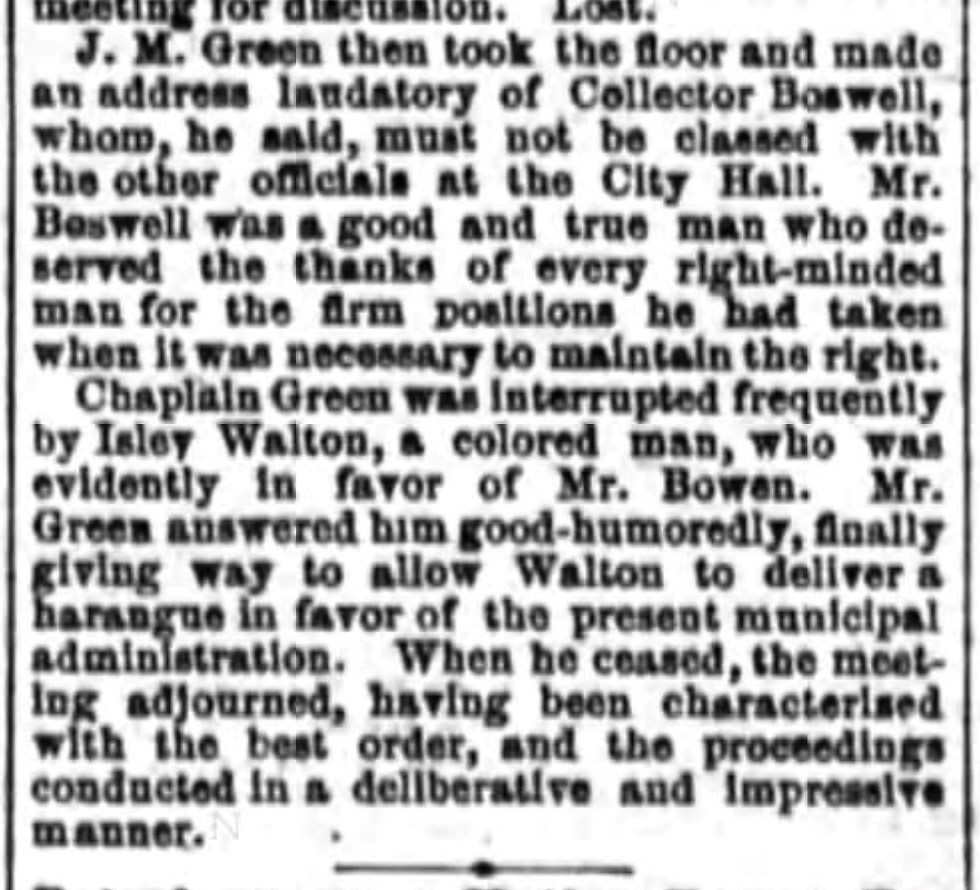
The meeting then went on to discuss and approve a constitution for the new reformed association now being called, “Independent Republican Reform Association.”[7] The meeting went on to discuss the problems that had resulted from Mayor Bowen’s administration. At the end of the evening, a Chaplain J. M. Green spoke. He spoke in support of a Collector Boswell in Mayor Bowen’s administration. The reporter for the National Republican noted that Chaplain Green was “interrupted frequently by Isley Walton [sic], a colored man, who was evidently in favor of Mr. Bowen.”[8] Apparently, Chaplain Green was not angered by the interruption but did grow frustrated as he “answered him good naturedly, finally giving way to allow Walton to deliver a harangue in favor of the present municipal administration.”[9] Chaplain Green may not have been distressed by Islay’s interruptions, but it appears that others had heard enough since the meeting adjourned after Islay finished speaking. Nevertheless, the meeting was “characterized with the best order, and the proceedings conducted in a deliberative and impressive manner.”[10]
Islay Walden speaking at Republican association meeting, National Republican, 7 February 1870
Mayor Sayles Jenks Bowen was defeated in 1870 by his Democratic opponent, Matthew Gault Emery.
There have been other hints at Islay’s interest in the political landscape of his time. Not long after arriving in Washington, D. C., in 1868, he went to Philadelphia to attend the Republican Convention, where General Grant was nominated the Presidential candidate for that year. He talked about that trip in the introduction to, and in, his poem, “Ode to Mr. Dunlap and Family.”[11]
1870 would have additional significance for Islay. That was year the Fifteenth Amendment was passed. Celebrations were held in Washington and around the country on 2 April 1870. Islay didn’t write a specific poem about his attendance of those celebrations. Rather, he references his presence in poems that address events around those celebrations. One poem he dedicated to a young girl, Clara Saunders, who helped him cross the street.[12] The other referenced Charles Sumner’s speech at that celebration.[13]
After reading about Islay’s assertiveness at the Republican meeting above, one cannot be surprised that Islay managed to have a personal meeting with President Ulysses Grant. In a letter to his niece, Catherine Hill, Islay mentioned that he had met the President, who encouraged him to never give up trying to get the education he sought. Islay added that he gave the President one of his poems.[14] It would be wonderful if the poem was preserved somewhere among Grant’s papers in the Presidential Library on the campus of Mississippi State University.
Islay’s political boldness continued as years went by. By 1883, he had returned to his home community in Randolph County, North Carolina. There, he founded a church and school, then known as Promised Land Church and a school, called Promised Land Academy. Islay had long been an advocate for temperance and apparently was a strong advocate in his community, even doing so before the North Carolina General Assembly. In March 1883, Islay was able to convince the General Assembly to pass “an Act to prohibit the sale of spirituous liquors within one (1) mile of the Promised Land Academy in New Hope Township, …”[15]
It is apparent that Islay Walden, who was a talented missionary and poet, was also a gifted politician. Sadly, he died at age 40, in February 1884, only a year after his victory in the General Assembly. I can’t help but wonder what he would have accomplished had he not died so young.
Islay Walden Death Notice in Alamance Gleaner, 28 February 1884, “gleaned” from Ashboro Courier.
Although Promised Land Academy is long gone, after serving the community’s children for over forty years, including my maternal ancestors, the church has continued to serve those in the community and descendants of the founding families, for 142 years, this past October (2021). In 2014, the church site, now known as “Strieby Congregational UCC Church,” became a Randolph County Cultural Heritage Site, and in 2021, was named a United for Libraries Literary Landmark.
[1] Tindall, William, “A Sketch of Mayor Sayles J. Bowen,” Records of the Columbia Historical Society, Washington, D.C., Vol. 18 (1915), pp. 25-43 Retrieved from: JSTOR.org
[2] “Reform: Large Meeting at Union League Hall,” National Republican, February 7, 1870, p. 4. Retrieved from: Newspapers.com.
[4] Islay Walden, in Letter to Mr. Beckley, January 20, 1868, Records of the Field Offices for the District of Columbia, Bureau of Refugees, Freedmen, and Abandoned Lands, 1865-1870; NARA M1902, Roll 19. Retrieved from: Ancestry.com
While I have focused heavily on the preservation of the history of Strieby Church and Islay Walden over the last nine years, the first story I worked to preserve was that of my maternal fourth great grandfather, Miles Lassiter, an early African American Quaker. Miles was accepted into the Uwharrie Preparatory Meeting of the Back Creek Monthly Meeting in Randolph County, in 1845. Sadly, he died merely five years later in June of 1850. At that time, he was the only African American Quaker in the state of North Carolina.
In the course of my research, my cousin, the late Harold Cleon Lassiter, shared with me several documents that had come down to him pertaining to Miles, his children, and the land the family owned. There was a handwritten letter from Miles’ son, Wiley, to his brother Colier, in 1858. There was a letter from then attorney Jonathan Worth (later Governor of North Carolina), naming Miles’ son Colier, Miles’ wife “Helia,” which outlined issues pertaining to the probate of Helia’s property. There was an invoice for medical treatment of my third great grandmother, Miles’ daughter, Nancy, and other documents which listed the names of all of Miles children and their birth dates, as well as land grants, plats, and deeds related to property owned by Miles and Helia (Healy).
After Harold’s death, I asked his daughter Patrice if she could locate the records and if she would give them to me. I said I wanted to find a way for them to be preserved safely. At that time, I had discussed with a curator at the North Carolina Museum of History whether he thought the North Carolina State Archives would be interested. He thought they might be. I contacted them, but shortly thereafter the Covid Pandemic forced the Archives to close, as did most archives. Thus, I did not hear back from the Archives.
Recently, I began to consider again what would be the best avenue for the preservation of these documents. I realized that I had worked with the Quaker Archives at Guilford College in Greensboro, North Carolina when writing my book on my research into Miles’ life. It occurred to me that the Archives might be interested in acquiring the documents. Thus, I contacted Gwen Erickson, the Archivist and Librarian there. She said they would love to have the papers to enhance their ability to tell Miles’ story and to have primary documentation on an African American Quaker from the pre-Civil War time-period. With that, I forwarded the documents which will be known as The Miles Lassiter Collection.
The Lela Virginia Farnell Williams Family Collection
The Autograph Book Belonging to My Grandmother, Lela Virginia Farnell Williams
The donation of the Miles Lassiter papers was not the first time I chose to donate to a university archive. In 2014, I travelled to Tallahassee, Florida to donate documents from my paternal family. That time, I donated an autograph book and family photos to the Carrie Meek and James Eaton, Sr. Southeastern Regional Black Archives Research Center and Museum.
I chose this repository specifically because the autograph book belonged to my grandmother, Lela Virginia Farnell Williams, who had been among the first students to attend the State Normal School for Colored Students, now Florida A & M University. The autograph book was signed by classmates and teachers, including Thomas DeSaille Tucker, the founding president. The Meek-Eaton Archives was particularly pleased to acquire the autograph book with President Tucker’s signature because they had had a fire a few years back which destroyed many original documents including those with President Tucker’s signature.
Another signature in the autograph book was that of teacher Ida Gibbs, wife of Vice President Thomas Van Renssalaer Gibbs. There is a fascinating irony to this connection. Vice President Gibbs had studied at Howard University at the same time as Islay Walden. Thus, Vice President Gibbs was an administrator and possible teacher to my paternal grandmother. Her son, my father, Herbert Randell Williams would marry my mother, Margaret Lilly Lee, whose grandmother, Mary Louise Smitherman, would have been a student at Strieby Church School when Islay Walden was the teacher.
It is repositories such as these university archives which can provide a place to consider donating any documents and pictures that may have an association with the university or archive. If no such relationship can be established, be sure to investigate whether other regional or historical societies may have an interest in documents and pictures whose long- term safety and preservation would be at risk. Future researchers will thank you.
Strieby is the name of an area and church in Union Township, in southwestern Randolph County, North Carolina. It is part of the area and church where my mother’s maternal family has lived and worshiped for over two hundred years. Although I did not grow up visiting Strieby, after having learned about its rich history and my family’s roots there, I became concerned that the history was being lost, especially as older family/community members died. Thus, over the years I have made use of various avenues and vehicles for preserving and uplifting the history of Strieby, the church, and the families associated with it.
Literary Landmark
From Strieby Church Literary Marker Award Letter
Just this past August 2021, Strieby Church was awarded the designation as a Literary Landmark, by United for Libraries (a division of the American Library Association), in recognition of the Rev. Islay Walden, its founding minister, a noted nineteenth century poet, dubbed the “Blind Poet of North Carolina” by Arthur Schomburg. Born enslaved in Randolph County, North Carolina, Islay walked to Washington, D. C. in search of an education and help for his near-blindness, most likely congenital cataracts. He received a scholarship to attend Howard University, but he still needed money for his personal needs. In 1872 (with revisions in 1873), he published Miscellaneous Poems Which the Author Desires to Dedicate to the Cause of Education and Humanity. After graduating from Howard, he received another scholarship to attend New Brunswick Theological Seminary, in New Jersey. Again, he published a small volume of poems called, Walden’s Sacred Poems with a Sketch of His Life, in 1877. After graduation and ordination in 1879, he returned to Randolph County where he founded Promised Land Congregational Church and School, renamed Strieby Congregational Church and School, in 1883, after he successfully petitioned the government for a post office for the Strieby community. He died on 2 February 1884 and was buried in Strieby Church Cemetery. According to the United for Libraries website, this is only the second Literary Landmark awarded in North Carolina. The marker will be dedicated on 5 February 2022.
Langston Hughes Community Library and Cultural Center Literary Marker
Where did I learn about Literary Landmarks? It is not a widely known national program. I learned about it when a library in the neighborhood where I grew up, dedicated to Langston Hughes and the home of the Black Heritage Reference Center of Queens County, was awarded its Literary Landmark status in 2013. I hoped to do the same, but it was only this year that I was able to work with other family members, descendants of the church’s founding members, and two community partners, Magnolia 23 Restaurant and Strieby Wood, LLC to successfully apply for Literary Landmark status for Strieby Congregational Church, School and Cemetery Cultural Heritage Site in honor of Islay Walden. However, this was not my first effort to preserve the history of this site.
Randolph County Cultural Heritage Site
Strieby Church, School & Cemetery Cultural Heritage Site Marker, Randolph County, NC
The first serious effort to preserve Strieby’s history was applying for Cultural Heritage Site status. Randolph County is unusual because it recognizes historical sites for their culturally significance regardless of whether any original, historical structures which had been associated with the site still exist or not. Thus, Strieby, whose original frame church building would have qualified for Historic Landmark designation, was demolished when it became unsafe in the early 1970s and was replaced by a new brick building, was able to qualify for Cultural Heritage Site designation. The site was awarded Cultural Heritage Site status in September 2014.
From Hill Town to Strieby: Education and the American Missionary Association in the Uwharrie “Back Country” of Randolph County, North Carolina (Backintyme Publishing)
The extensive research necessary to ensure a successful application for Cultural Heritage Site status, provided a strong basis for a book on the history of the community of Strieby that grew up around the church and school. The book focused on the educational achievements of the school during its forty years serving the community that grew up around Strieby Church. The book also included four generation summaries of the two principal founding families, the Hills and the Lassiters. In addition, it included the names and relationships of all those buried in the cemetery with grave markers as well as the names of about 35 individuals who were buried there with no grave markers, but whose internments were identified from death certificates. The book was published in 2016.
Born Missionary: The Islay Walden Story (Margo Lee Williams, Personal Prologue)
While researching Strieby’s history, for the book, From Hill Town to Strieby, I realized there was much more to Islay Walden’s background than is normally reported. It seemed a natural progression to go from writing about the history of the church and school, to writing about the story of Islay Walden, founding pastor and teacher. While I recognize his contribution as a nineteenth century, formerly enslaved, African American man to the field of poetry, I realized through my research that Islay Walden’s focus was education and spiritual development. Thus, the phrase used to describe him in an obituary, “Born Missionary,” became my title for the book that came out in April 2021.
North Carolina State Cemetery Survey
Strieby Church Cemetery
North Carolina has a state initiative through the Department of Natural and Cultural Resources aimed at identifying and surveying every cemetery in North Carolina, whether public, private, church owned, municipal, slave, Native American, or whatever. Surveys can be undertaken by local governments, private groups, or individuals. One can add information or pictures, or whatever, to the file that provides any important background information on the cemetery and the people buried there. I was able to complete and submit the survey for Strieby Church Cemetery this past summer, 2021.
North Carolina State Highway Marker
Sadly, not every effort to preserve the history of Strieby and Islay Walden has been successful. I applied to the State Highway Marker program in 2016 for a marker for Islay Walden. It was denied. I was able to gather additional information and reapplied in 2018. Unfortunately, it met the same fate. The committee reportedly denied the application because they felt that Islay Walden, though widely recognized for his poetry, had only regional, local significance. Since only two attempts are permitted, this avenue for preservation of Islay Walden’s story and that of Strieby is no longer viable. It was this dismissal that spurred me to seek more earnestly the Literary Landmark marker for Islay Walden.
I have Walkers in my family, but I wasn’t doing any research on the family at the moment. Recently, I happened to check a Facebook message on a group page I belong to. Someone had posted information about the Race and Slavery Petitions Project,[1] in the Digital Library on American Slavery at the University of North Carolina-Greensboro. I hadn’t looked at this database for quite a while. I decided to look at the petitions for Randolph County right then.
Most of the petitions were from groups of white residents imploring the state to restrict free people from other states (probably mostly from Virginia) from entering North Carolina. These petitions were mostly in 1827, with a few more in 1834. However, there was one petition by Robert Walker to free James Walker, age 40, in 1835.
Robert explained to the legislature that James was an honorable man, hard working who was married to a free woman and that they had five children. Robert went on to say that it would greatly improve James’ ability to care for his family if he could be free to join his family full time. However, the legislature did not agree. Robert was admonished that the only qualification for manumission was meritorious service. They also mentioned the “present highly excited state of the times,” probably referring to Nat Turner Rebellion of just a few years before. Petition denied. Fortunately, that was not the end of the story.
Petition for freedom of James Walker
In the 1850 census, James and his wife Absily and their three children, Amy, Franklin and Henderson, were listed as free.[2] They were living next to Robert Walker and his family. Was there any evidence that Absily was the wife that Robert was referencing in the petition?
James and Absilly Walker, 1850, Randolph County, NC
Robert Walker said in his petition that James’ wife was a free woman. Looking back at the 1840 census, I wondered if there were any free people of color living in his household. There was. There was one male, in the age category, 10-23. No slaves. Listed in the next household was a woman of color named “Absila Moze.”[3] There were seven people in her household: one male under 10; one 10-23; one 24-35; one female under 10; two females 10-23; and one 36-54. It’s difficult to say exactly who is whom. However, based on Robert saying James was 40 in 1835, none of these age groups seems appropriate. In the 1850 census, James is listed as age 53 (not 93 as the abstractor wrote). Ten years earlier he would be 43, so not the age of any of the men listed in either Robert’s household or Absila’s. Was he there but listed with the wrong age group? Was he somewhere else? It’s impossible to know. Absila, on the other hand, was listed as 48 in 1850, so she was likely the female 36-54 in the 1840 census.
1840 census, Absilla Moze
All that aside, how was James a free man in 1850 when the legislature denied the petition and there does not appear to have been any additional petition? There’s no indication. It seems that Robert simply decided to give James his freedom despite the legislature. Lucky man!
James does not appear in the 1860 census. Neither does Absila. In November 1855, a Thomas Walker filed for letters of administration for the estate of Absila Walker.[4] It was an intestate probate. Since James was not the one seeking the letters, it can be assumed he was already dead. Thomas relationship was not specified, but there was no Thomas of color in the 1850 or 1860 census. None of those purchasing items from the estate were identified by relationship. There were the recognizable names of Amy, Henderson, and Franklin. There were other Walkers purchasing items, but there was no way to know from the estate documents how they were or were not related.
It doesn’t matter. What matters was that James and Absila were able to live out their lives as free persons, despite legal obstacles. Lucky indeed!
References
[1] Race & Slavery Petitions Project. ( ). Par Number 11283502; Petitioner: Robert Walker. Digital Library on American Slavery, University of North Carolina-Greensboro. Retrieved from: Petition for Freedom of James Walker
[2] 1850 US Federal Census, Southern Division, Randolph County, North Carolina; James Walker, head. NARA Roll: M432-641; Page: 139B; Image: 285. Retrieved from: Ancestry.com
[3] 1840 US Federal Census; South Division, Randolph County, North Carolina; Absila Moze of color, head. NARA Roll: 369; Page: 77; Family History Library Film: 0018097. Retrieved from: Ancestry.com
[4] North Carolina, Wills and Probate Records, 1665-1998 [Database on-line]. Absilly Walker, petition for letters of administration by Thomas Walker, November Term 1855. Images 721-733. Retrieved from: Ancestry.com
#52Ancestors – Fresh Start: How DNA rewrote my genealogy
After many years of research on my mother’s family, I had a solidly documented family tree. In fact, I had published a book on that family. Now, the central ancestor of that story, Miles Lassiter, is still firmly in place on my tree. My direct line to him is firmly established. He was my fourth great grandfather, my mother’s, mother’s, mother’s, mother’s, mother’s, father. It’s the spouses that were the problem. I couldn’t see it at first. After all, I had documented everything.
It all started when I became troubled over my efforts to confirm DNA documentation of my third great grandfather, Calvin Dunson, married to Miles Lassiter’s daughter, by his wife, Healy Phillips Lassiter, Nancy Phillips Lassiter. Miles was technically enslaved by the Widow Sarah Lassiter, but Healy, called Healy/Helia/Heley Phillips in most records, was a free woman of color. Thus, all her children with Miles were originally known in public records by the name “Phillips,” rather than Lassiter, since children followed the condition of their mothers, i. e., if enslaved they were enslaved, if free, then the children were free. After Miles was freed from the Widow Lassiter’s estate when purchased by his wife Healy, Nancy and her siblings began to be known by the Lassiter name, though not consistently.[1]
One of the difficulties in determining when Nancy and Calvin married was that no marriage bond has survived. In fact, there may never have been one because they were not a requirement for marriage. On the other hand, I’m not sure why they wouldn’t have sought one since Nancy’s brother, Colier, had one when he married Katherine Polk, though there was none found for the marriage of her other brother, Wiley Lassiter and wife, Elizabeth Ridge. To estimate the date of marriage for Nancy and Calvin, I used the birth date of their oldest daughter, Ellen, my 2nd great grandmother. According to the 1860 census,[2] Ellen was born about 1851; however, her death certificate said 1854. Based on the census, it appeared that Nancy and Calvin had four other children: Rebecca, J. Richard, Martha Ann, and Mary Adelaide. I did find that J. Richard was the child of a possible rape. Nancy sued the perpetrator. I’ve never found any information on the named assailant. Additionally, it appeared that Richard died sometime after 1870. After that, he no longer appeared in the census or other records with the family and he was not named with the other siblings as an heir to the Lassiter estate. So, I determined that Nancy and Calvin married between 1851 and 1854.
Calvin and Nancy Dunson and children (Ellen, Sarah Rebecca, and Richard. Emsley was not one of their children), 1860 Census
Fast forward to my DNA testing.[3] I kept looking for Dunson/Dunston matches. I found one in AncestryDNA. I had hundreds of matches but only one person had a Dunson in her family. Even at that, it appeared that it was one of her other lines that was my connection to her. So, she probably wasn’t a Dunson match.
While at a genealogy conference, I mentioned my puzzlement to some of my genie friends and colleagues. One mentioned that she was a Dunson descendant. With that we began searching to see if we were a match or if I matched any of her other known Dunson cousins who had DNA tested. She checked especially on GEDmatch, a third-party site when individuals having tested their DNA on various sites can upload their results, thus expanding their chances of learning about more family members. We did not find a single match. Not one. I figured that my branch did not have descendants who had tested yet or uploaded to GEDmatch. This was several years ago when the databases did not have the numbers of individuals who have tested that they have today. Still, it bothered me. I had it documented in multiple places, Calvin Dunson was the spouse of Nancy Lassiter and the father of Ellen. I couldn’t explain the DNA; it was a conundrum.
One day I was talking to someone, G. C., who was commenting on the connections between his Cranford ancestors, especially Samuel “Sawney” Cranford, and Miles Lassiter. He noted that they were both Quakers, members of the same Meeting. I commented that, apparently, we didn’t just have business and social dealings, but we were somehow related. I told him I had several Cranford DNA matches. I speculated that if he tested, we might be a DNA match as well. After we got off the phone, I was reflecting on our conversation, when I suddenly had a revelation. I realized that I needed to follow the DNA to find the answers. I needed to let the DNA tell me what the genealogy was, not just the paper trail.
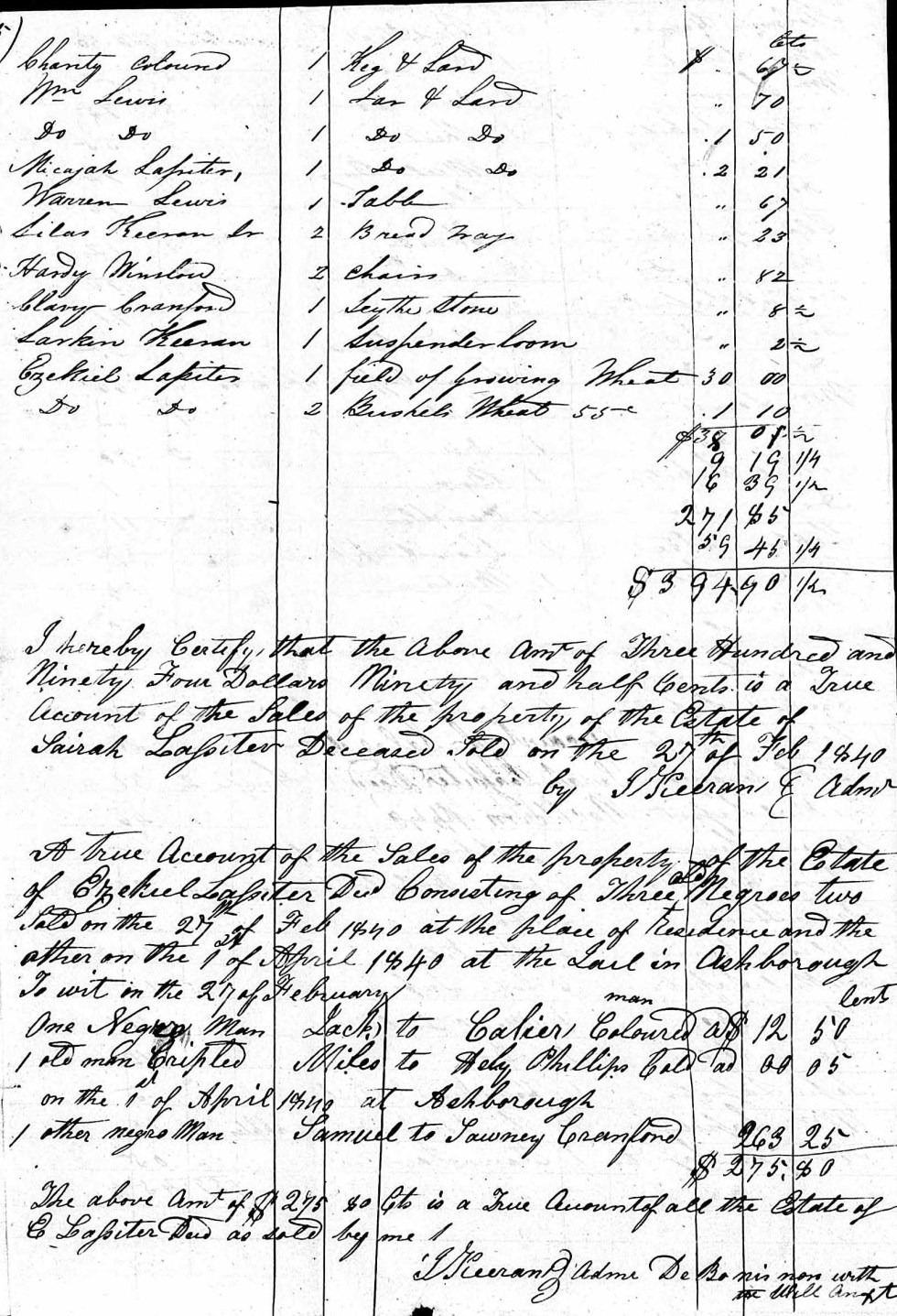
It occurred to me that Sawney Cranford had played an important role in the lives of Miles and his brothers, Jack and Samuel, especially Samuel. When the Widow Lassiter died, a final stipulation of her husband Ezekiel’s will was enforced. According to the will, Miles, Samuel, and Jack were to be under the control of Ezekiel’s widow until she died. She died in 1840, at which time both estates reached final settlements.[4] As part of Ezekiel’s final accounting, the only property mentioned were the three men, old men at this point. They were offered for sale. Miles’ wife, Healy, purchased him from the estate. Miles’ son, Colier, purchased Jack. Both men were purchased for nominal amounts of money. However, according to the estate information, Samuel had been a runaway, apprehended in Raleigh. There were associated expenses with his capture: newspaper ads, jail time, transport back to Randolph County. The fees, $262 worth, were paid by Sawney Cranford, thus purchasing Samuel. That’s the same Sawney Cranford who was G. C.’s ancestor. I realized that my DNA matches were also descendants of Sawney Cranford. A light bulb went off. I was descended from Sawney Cranford! If that was true, where was the connection? Sawney was a contemporary of Miles and Healy. So, his children were contemporaries of Miles’ children, well some of his children anyway. Sawney had children that spread over a wide time period. Based on the centimorgans (cMs), I shared a third great grandparent. Well, it wasn’t Nancy or Calvin was my first thought. That doesn’t make sense. I had the documentation, but the DNA seemed to be saying otherwise. Then I began to think back to some other documents I had.
From the Account of Sales of the Estate of Ezekiel Lassiter, 27 Feb & 1 Apr 1840,Three Negroes: Miles, Jack & Samuel.
After Miles died, it appears that there was a need to raise funds. Miles’ son, Colier, began purchasing interests in the family land from his siblings and then taking out a Deed of trust. As part of that process there seemed to be a hastily filed intestate probate for Miles’ wife, Healy, called “Healy Phillips or Lassiter.” Oddly the document had no date on them. However, they were filed in Will Book 10, which covered the years 1853-1856 with Healy’s papers mixed in with others from 1854 and 1855.[5] In them, all the children, heirs, were named, including Nancy. She, like her siblings, was called “Phillips or Lassiter.” There was no mention of her being married in any of the above-named documents.
Heirs at Law of Healy Phillips
One clue to these legal actions seemed to be found in a letter written in 1851, on behalf of Colier, by Jonathan Worth, a local attorney who later became governor of North Carolina. In the letter, Worth stated that Healy had four children from a previous marriage, with whom it would be necessary to share her estate along with the seven children with Miles. The other alternative was to buy out the four other children. I’m speculating that the other documents pointed to efforts to raise the monies to buy out the four half siblings. What I realized also was that not one of these documents referred to my 3rd great grandmother, Nancy, as Nancy Dunson, wife of Calvin Dunson. Not one.
Jonathan Worth Letter (P. 1)
Jonathan Worth Letter (P. 2)
The first time Nancy is referenced as married in any public document located so far by me was in the lawsuit for the assault and subsequent bastardy bond in 1858.[6] By that time, not only was there the son, J. Richard, subject of the lawsuit, but another sister, Sarah Rebecca, born about 1857. Therefore, there is reasonably solid information that Ellen was born between 1851-1854. There was one more piece of information that helped determine her age, her marriage certificate. The record I had seen does not mention her age. That’s okay, because using her date of marriage was sufficient.[7]
Marriage Record of Ellen Dunson & Anderson Smitherman, 23 Sep 1865
Ellen Dunson married Anderson Smitherman on 23 Sep 1865, in Randolph County. I repeat, 1865. If Ellen was born as late as 1854, she would only have been 11 years old. I know that there were no regulations for minimum age in those days, but eleven is extremely young. I really can’t say that I can find another incidence of an eleven-year old marrying in my family. There may be some in other families, but not in mine. It is far more likely that Ellen was born in 1851 or 52. That would make her thirteen or fourteen when she married, still very young, but not unprecedented. With that reality, it was most likely that Ellen was not the biological child of Calvin Dunson, even though she carried the Dunson name, was named as one of his heirs,[8] and his name was listed as her father on her death certificate.[9] I realized Ellen was born five years before her next closest sibling, Sarah Rebecca, was born, or before any legal documents referred to Nancy as Nancy Dunson, wife of Calvin Dunson.[10] Putting it all together, it appeared that my 2nd great grandmother Ellen was most likely the Cranford descendant.
Calvin and Nancy Dunson Family, 1870 Census
Based on my DNA matches, it appeared that the most likely candidate was a son, Henry. My closest matches are with his direct descendants. Altogether I have identified 32 of my matches as Cranford descendants. At this time, I have no information that sheds any light on what led to Nancy having a child with Henry. They were not cited in the Bastardy Bonds of the time. I can’t really say I’m very concerned with that. What I do know is that I have since developed a very good relationship and communication with G. C. and other Cranford relatives. I also still have an interest in the Dunsons because Calvin and Nancy’s descendants are still my cousins. They do have a Dunson legacy.
DNA has expanded, broadened, my family connections and given me new perspectives on my relationship to my community, Randolph County. DNA has helped me break down brick walls and confirmed oral tradition and given me the surprise of rewriting my family story. Did I say “surprise,” singular? My mistake. Yup, I realized I had another ancestor who was well documented, but whom DNA said was not my ancestor, in the same family line! This time, it was my great grandfather, … but that’s a story for another day.
[2] 1860 US Federal Census, Western Division, Randolph, North Carolina; Calvin Dunson, head; Nancy Dunson, & Eallen [sic] Dunson, age 9; Sarah, age 3; Richard, age 1. NARA Roll: M653-910; Page: 212; Image: 429; Family History Library Film: 803910. Retrieved from: Ancestry.com
[3] My DNA testing referenced in this article is specific to my matches at AncestryDNA.
[4] Obituary of Miles Lassiter. (1850, June 22). Friends Review iii,700.
[5] Estate of Healy Phillips or Lassiter. (1854-1855). Randolph County, Randolph County, North Carolina Will Book 10:190-192. FHLM #0019645. See also North Carolina, Wills and Probate Records, 1665-1998. [Database and Images on-line] Henly Phillips. Digital Images: 1225-1229. Retrieved from: Ancestry.com
[6] Nancy Dunson v. John Hinshaw, 2 November 1858, Minutes of the Court of Common Pleas and Quarter Sessions, FHLM #0470212 or #0019653.
[7] North Carolina, Marriage Records, 1741-2011 [Database and Images on-line]. Anderson Smitherman and Ellen Dunson, 23 Sep 1865. Retrieved from: Ancestry.com
[8] North Carolina, Wills and Probate Records, 1665-1998 [Database and Images on-line]. William Dunston, 1892. Digital Images 1393-1398. Retrieved from: Ancestry.com
[9] North Carolina, Death Certificates, 1909-1975 [Database and Images online]. Ellen Mayo, died: 12 Jun 1920. Retrieved from: Ancestry.com
[10] 1870 US Federal Census: New Hope, Randolph, North Carolina; Calvin Dunson, head; Nancy Dunson; S. A. R. (Sarah Rebecca); J. A. [sic] (J. Richard); M. A. (Mary Adelaide); and M. Ann (Martha Ann). NARA Roll: M593-1156; Page: 400B; Image: 250; Family History Library Film: 552655. Retrieved from: Ancestry.com
In a previous post, I wrote about Mary Polk/Pope and her children, Harriett, Katherine, Sarah, Lunda, and Malcom. At that time, I was not certain what had happened to Elizabeth, “Lissie.” Looking back through the records I had about the other siblings, I realized that she was living next door to Malcom, her brother Malcom Pope/Polk, and his wife, Nancy (Smitherman) in 1880 in Richmond County adjacent to Montgomery County, which is adjacent to Randolph County.[1]
Andrew and Elizabeth “Lissie” (Pope) Leak, 1880 Census, Richmond County, NC
Elizabeth and her husband Andrew Leak, along with their children had not shown up in the census until 1880. At that time, they could be found living in Steeles Township, in Richmond County, North Carolina. Richmond County abuts Montgomery County where her mother and brother could be found living previously.[2] In the home, are their children: Archie, Sarah, Lissie A(nn), Martha A., James, and (Le)Nora. Having found them in 1880, I tried to find them in 1870. That was not quite as easy.
Marriage Certificate for Andrew Leak and Elizabeth Pope, 13 April 1875, Montgomery County, NC
One curious discovery was that Andrew and “Lissie” didn’t marry until 13 April 1875, in Montgomery County.[3] Thus, of the children named in 1880, only Martha, James and Nora were born after their reported marriage. So, what about Archie, Sarah, and Lissie? They could be found in 1870 in Steeles Township, Richmond County, living with Rachel Little. So where were Andrew and Lissie? Good question.
Mary C., Archie, Sarah, and Ann E. Leak, 1870 Census, Steeles Township, Richmond County, NC
In 1866, an Andrew Leak and Eliza Hunsacker married in Richmond County.[4] In 1870, their household, in the Mineral Springs Township of Richmond County, included Andrew, Eliza, and three children, Thomas, Annie, and Mary.[5] Were these Andrew and Eliza the same as Andrew and Elizabeth Pope/Polk? If so, why were they living in Mineral Springs Township, while Mary, Archie, Sarah, and Ann E. (Lissie) were living in the Steeles community with Rachel Little?
Andrew Leak and Eliza (Hunsacker) Leak, 1870 Census, Richmond County, NC
In 1880, Andrew and Eliza were in Williamson Township in Richmond County. They were living there with their children: Anna, Charlie, Jessie, Winston, Della, and Thomas.[6] Meanwhile, Andrew and Elizabeth Polk/Pope were living in Steeles Township of Richmond County with their children: Archie, Sarah, Lissie, Martha, James, and (Le)Nora.[7] These clearly were not the same couple. In addition, Andrew, who lived in Steeles, was born about 1827, while Andrew living in Rockingham was born about 1846. These were not the same Andrew. Despite these differences, some have become confused by the similarity of names and location in the same county, not noticing that they were of different ages, in different communities with different children. Thus examining the records showed that Andrew and Eliza Hunsacker were not our Andrew and Lissie. So, what happened to our Andrew and Lissie?
Sometime after 1886 when their youngest child Dovie was born, Lissie moved to Arkansas.[8] She probably traveled with her children. There in 1888, daughter Sarah married her cousin, Milton Hill who was born in Strieby, Randolph County, North Carolina.[9] Milton was the son of Nathan and Sarah Polk/Pope Hill.[10] Sarah was Elizabeth’s older sister. There’s no evidence for whether Andrew, made the trip to Arkansas. According to the 1900 census, Lissie was widowed.[11] Thus, there is no additional information about Andrew. Lissie would continue to live amongst her family members, including her children and grandchildren, until her death sometime after 1920, when she appeared in the census for the last time.[12]
Elizabeth “Lissie” (Pope) Leak, 1920 Census, Jefferson County, Arkansas.
Over time, Lissie’s descendants and Milton’s family in North Carolina lost touch with one another. Lissie’s descendants knew they were from Randolph County, but didn’t know many details. Sadly, the family left in North Carolina had no idea about Milton and Sarah’s family in Arkansas. It was their DNA matches that helped reunite the two branches of the family. In 2018, they were able to reunite at a family reunion in North Carolina, during which Milton and Sarah’s descendants were able to visit Strieby Church and Cemetery Cultural Heritage Site, where Milton’s ancestors are buried.[13]
Strieby Church, School & Cemetery Cultural Heritage Site Marker, Randolph County, NC
References
[1] 1880 US Federal Census: Steeles, Richmond County, North Carolina; Andrew Leak, head; Dwelling/Family #125; Macam Pope, head; Dwelling/Family #126. NARA Roll: 978; Family History Film: 1254978; Page: 231D; Enumeration District: 165; Image: 0755. Retrieved from: Ancestry.com
[2] 1850 US Federal Census (Free population): Montgomery County, North Carolina; John McLeod, head; Mary Pope, age 40; Malcom Pope, age 4. NARA Roll: M432-637; Page: 127B; Image: 264. Retrieved from: Ancestry.com
[3] North Carolina, Marriage Records, 1741-2011 [Database on-line]. Andrew Leak and Elizabeth Pope, 13 April 1865, Montgomery County, North Carolina. Retrieved from: Ancestry.com
[4] North Carolina, Marriage Records, 1741-2011 [Database on-line]. Andrew Leak and Eliza Hunsacker, 5 Aug 1866, Richmond County, North Carolina. Retrieved from: Ancestry.com
[5] 1870 US Federal Census: Mineral Springs, Richmond County, North Carolina; Andrew Leak, head. NARA Roll: M593-1156; Page: 568A; Family History Library Film: 552655. Retrieved from: Ancestry.com
[6] 1880 US Federal Census: Williamson, Richmond County, North Carolina; Andrew Leak, head; Eliza Leak, wife. NARA Roll: 979; Page: 349C; Enumeration District: 171. Retrieved from: Ancestry.com
[7] 1880 US Federal Census: Steeles, Richmond County, North Carolina; Andrew Leak, head; Dwelling/Family #125. NARA Roll: 978; Family History Film: 1254978; Page: 231D; Enumeration District: 165; Image: 0755. Retrieved from: Ancestry.com
[8] 1900 US Federal Census: Jefferson, Jefferson County, Arkansas; Page: 5; Enumeration District: 0087; James Leak, head; Dovie Leak, Sister; Born Feb 1886; born North Carolina; Lissie Leak, Mother. FHL microfilm: 1240063. Retrieved from Ancestry.com
[9] Arkansas, County Marriages Index, 1837-1957 [Database on-line]. Milton Hill and Sarah Ann Leek, married 26 May 1888, Jefferson County, North Carolina. Retrieved from: Ancestry.com
[10] 1880 US Federal Census: Union, Randolph County, North Carolina; Nathan Hill, head; Sarah Hill, wife; Milton Hill, son. NARA Roll: 978; Family History Film: 1254978; Page: 196C; Enumeration District: 224; Image: 0683. Retrieved from: Ancestry.com
[11] 1900 US Federal Census: Jefferson, Jefferson County, Arkansas; Page: 5; Enumeration District: 0087; James Leak, head; Lissie Leak, “widowed.” FHL microfilm: 1240063. Retrieved from Ancestry.com
[12] 1920 US Federal Census: Pastoria, Jefferson County, Arkansas; Leroy Hampton, head; Elizabeth Leek, grandmother. NARA Roll: T625-67; Page: 17B; Enumeration District: 124; Image: 421. Retrieved from: Ancestry.com
I first saw Mary “Polly” Polk/Pope’s name on the 1880 census. She was living in the home of Colier and Kate Lassiter, in the Lassiter Mill area of New Hope Township in Randolph County.[1] The area runs along the Uwharrie River on the edge of the Uwharrie Mountains in what is today the Uwharrie National Forest.[2] Mary was listed as “white,” the rest of the Lassiter family was listed as “black.” The census didn’t mention a relationship for Mary to the Lassiter family other than “boarder.” However, I already knew that Colier’s wife’s maiden name was “Polk.”
Katherine Polk Lassiter
Colier and Katherine had married in 1854.[3] Unfortunately, the marriage records in that time period did not ask the names of parents. Nevertheless, I speculated that Mary was very possibly Katherine’s (Kate’s) mother. At that time, I thought the “w” for white might have been accidentally written instead of “m” for “mulatto.” (Census schedules were transcribed from field notes which could lead to errors.) Mary was not living with the family in either 1870 or 1860. I didn’t find either Katherine or Mary in 1850, at that time.
Colier and Katherine (Polk), Mary Polk, and family, 1880 Census, Randolph County, NC
In 1853, the year before Colier and Kate married, Colier Lassiter posted bond for the marriage of Sarah Polk and Nathan Case (known as Nathan Hill in all census records). It seemed likely the two women were related.[4] In 1860, Nathan, Sarah and their children were identified as black.[5] Like Katherine, I did not find Sarah Polk in earlier census records. Was it an oversight, part of an undercount?
Nathan and Sarah (Polk) Hill, and family, 1860 Census, Randolph County, NC
Both Katherine and Sarah had married into large families that were founding members of the First Congregational Church of Randolph County, now called Strieby Congregational Church.[6] Another member of that church community was “Aunt Harriet” Cotton. Harriet had married Micajah McDuffie, also known as Micajah Cotton in 1854.[7] In 1860, Mary, called “Polly Pope,” was living with Micajah and Harriet.[8] They were all being called “mulatto” in 1860. Mary was also named as Harriet’s mother on her death certificate, where she was listed as “Polly Pope.”[9]
Micajah and Harriet (Polk/Pope) Cotton, and family, 1860 Census, Randolph County, NC
There was another Polk family in the area that seemed to be related, the Macam (Malcom) Polk/Pope family. Malcom married Nancy Jane Smitherman in 1865.[10] In 1870, Malcom was listed as mulatto, but Nancy was listed as black. Around 1881, Malcom and Nancy would leave North Carolina and move first to Mississippi, eventually settling in Arkansas. In 1900, Malcom and Nancy and some of their children were living next door to the family of her nephew-in-law, Thomas Julius Hill, son of Nathan and Sarah Polk Hill, in Jefferson County, Arkansas. [11]
Malcom and Nancy J. (Smitherman) Polk/Pope, and family, 1900 Census, Jefferson County, Arkansas
I was still looking for more information on each of these Polk family members. The fact that Mary, “Polly,” was living in “Aunt” Harriet Polk Cotton’s home in 1860 and Katherine Polk Lassiter’s home in 1880, convinced me that Harriet and Katherine were likely sisters. Additional searches found Mary living in neighboring Montgomery County in 1850 with two children, Malcom and Lunda.[12] Mary was listed as white, but the children were listed as mulatto. They were living in the home of a John McLeod, just a few houses away from Micajah McDuffie, who was living in the home of Thomas L. Cotton.[13] It seemed from this that Mary was most likely white. It also confirmed that Katherine, Harriet and Malcom were most likely siblings. It also seemed likely that Sarah was a sibling, based on Colier Lassiter posting bond for her marriage. It seemed a reasonable conclusion since he would go on to marry Katherine Polk and Mary would live with them in her later years.
Mary Polk/Pope, Malcom Polk/Pope, and Lunda Polk/Pope, in the home of John McLeod, 1850 Census, Montgomery County, NC
I also found Harriet in 1850. Harriet Polk and Elizabeth Polk were living in the home of Levi Nichols. Harriet and Elizabeth were identified as white.[14] Levi Nichols would develop a relationship with Hannah McDuffie Cotton, sister of Micajah McDuffie Cotton who married Harriet. Levi and Hannah would have two children by 1860[15] and be charged with fornication[16] before they would eventually marry in 1867.[17] At that time, Levi adopted the identity of a man of color. Similarly, when Harriet married Micajah in 1854, she adopted the identity of a woman of color.[18] However, where were Katherine and Sarah in 1850?
Levi Nichols, Harriet Polk, and Elizabeth Polk, 1850 Census, Montgomery County, NC.
Looking over my research and the 1850 census again for the southern part of Randolph County, where these families lived, I realized that I had been looking at Katherine and Sarah all along. They were living in the home of an older couple, Jack and Charity Lassiter.[19] Jack was the half-brother of Colier’s father, Miles Lassiter.[20] Katherine and Sarah were being called Lassiter. At this point I was fairly certain that they were not related to Jack, but possibly were related to Charity. Charity was old enough to be their grandmother. Jack, Charity, Katherine and Sarah were all identified in this record as white. In 1860, Jack and Charity were identified as mulatto. By 1870, Jack had died, and Charity was living in the home of Colier and Katherine Polk Lassiter, who had a daughter named (Rhodemia) Charity.[21] The older Charity was identified as mulatto. Charity presumably died after 1870; she is not found again in the census.
Jack and Charity (Polk?) Lassiter, 1850 Census, Randolph County, NC. Katherine and Sarah Polk, are called “Lassiter” here.
Not everything about this family can be confirmed beyond a doubt. However, with the above information along with information from descendants (and DNA results), the following picture has emerged:
Mary “Polly” Polk/Pope was identified as white in 1850. Though identified as mulatto in 1860, she was identified again as white in 1880. She was not found in 1870. She is presumed to be the daughter of Charity (Polk?) Lassiter, identified as white in 1850, but mulatto in 1860. Mary is believed to have had the following children:
Katherine Polk, identified as white in 1850, who married Colier Lassiter, a man of color, in 1854 and was thereafter identified as a woman of color.
Sarah Polk, identified as white in 1850, who married Nathan Hill, a man of color, in 1853 and was thereafter identified as a woman of color.
Harriet Polk, identified as white in 1850, who married Micajah McDuffie Cotton, a man of color, in 1854 and was thereafter identified as a woman of color.
Elizabeth Polk, identified as white, but no further information is known at this time.
Malcom Polk/Pope, identified as mulatto in 1850. He married Nancy Jane Smitherman, a woman of color.
Lunda Polk, identified as mulatto in 1850. She was still living with John McLeod in 1860. No other information is known at this time.
It is difficult to know what prompted these women to choose men of color. Perhaps what is a better question is what about southwestern Randolph County made it a place where interracial marriages seemed to thrive with no obvious community opprobrium. I’m not suggesting that the surrounding white community was throwing these couples wedding celebrations. I am saying that unlike other areas in the South, these families were not being persecuted; the men were not being prosecuted or persecuted for having married these women. In fact, these families were landowners and leaders in their communities, reportedly respected by their neighbors, both white and black. What made Randolph County different?
Southwestern Randolph County was heavily Quaker and anti-slavery, but there was also a large Methodist population, some “Methodist Protestant,” some “Wesleyan.” There were also some enslavers, though very few had large numbers of enslaved people. Most people were family farmers with free laborer assistants. There was a significant number of free people of color, 92 in southwestern Randolph County alone in 1850. Many had been freed or born to those freed by their Quaker (primarily) enslavers in the 1790s or early 1800s as the Society of Friends began to require manumission of slaves as a prerequisite of membership.[22] Quaker influences were strong in this part of Randolph County, but that’s not all. Randolph County was not a typical southern community.
In her book, Unruly Women: The Politics of Social and Sexual Control in the Old South (1992), Victoria Bynum talked about Randolph County’s rebellious history.[23] Even today when talking to local historians they will tell you proudly that Randolph County was against secession. During the war, North Carolina had the greatest number of deserters from the Confederate army and Randolph County had the greatest number of these, 22%, compared with the state average of 12%.[24]
Unionism, as it was called, was heavy in the “Quaker Belt,” especially Randolph County, Bynum stated. This was not just a matter of politics, but also economics. There were growing textile and tobacco industries, she said, artisans and yeoman farmers who didn’t want the disadvantages of competing with slave labor, along with the religious objections to slavery of Quakers, Wesleyans, and Moravians .[25]
In discussing interracial relationships, Bynum said that counties such as Randolph’s neighbor to the south, Montgomery County, were more tolerant because they had only a small number of free blacks and a relatively homogeneous white population.[26] I’m not sure I agree with her. I think the larger population of free people of color and the more diverse white population made Randolph a more accepting community than Montgomery County. I notice that not only Mary Polk and her children moved into Randolph County, but Levi and Hannah McDuffie/Cotton Nichols and Micajah McDuffie/Cotton did as well.
It is notable that Levi Nichols (a white male) and Hannah McDuffie/Cotton (a free woman of color) had been brought into Montgomery County court on charges of fornication. However, on close examination it becomes apparent that the accusations weren’t only because they were in an illicit, interracial relationship as much as they were being targeted for revenge from an ongoing feud involving Levi’s brother and niece. It seems entirely likely that their move to Randolph County was an attempt to get away from what had become a round-robin of accusation and counter-accusation, leading to lawsuit and counter-lawsuit.[27]
Accusation of Fornication against Levi Nichols and Hannah McDuffie/Cotton, 1858, Montgomery County, NC (In Bynum, Unruly Women)
One might have expected greater outcry over the relationships of the Polk women who were reportedly white and married free men of color. Yet their relationships met no known violence or any legal obstacles in Randolph County. Martha Hodes in her book, White Women, Black Men: Illicit Sex in the Nineteenth Century South (1997), points out that these white-black sexual liaisons (with or without marriage) in the antebellum South were not met with the violence that accompanied the post-Reconstruction and Jim Crow years, right into the Civil Rights era. She states,
“Scholars agree that the most virulent racist ideology about black male sexuality emerged in the decades that followed the Civil War, and some historians have recognized that the lynching of black men or the alleged rape of white women was comparatively rare in the South under slavery.”[28]
Hodes admits that statistics are difficult to gather in the ante-bellum period because these relationships were not found in historical records under one universal category. Rather they were gleaned from a variety of records covering such categories as domestic violence, murder, fornication, adultery, bastardy, assault, and others. She notes that even the word “miscegenation” was unknown before the Civil War era.[29]
Despite the lack of violence in the antebellum years, there was not necessarily acceptance or even tolerance, which she says implies a liberality of attitude. Rather, she says, these relationships were met with toleration, forbearance. She goes on to make the point that forbearance did not mean there wasn’t cruel gossip, or that individuals weren’t ostracized.[30] What changed after the Civil War?
Hodes said that Frederick Douglass explained that accusations of sexual transgressions against white women increased with black men’s new political power, with the conferring of citizenship and the right to vote. Ida B. Wells observed that lynching, often as a result of accusations of sexual assaults on white women, was intended to suppress the black vote by the threat of deatn.[31] By contrast, Hodes notes that these white-black relationships in the ante-bellum South did not threaten the overall social and political hierarchy. She states that “[f]or whites to refrain from immediate legal action and public violence when confronted with liaisons between white women and black men helped them to mask some of the flaws of the antebellum Southern systems of race and gender.”[32] On the other hand, she notes that the children of these liaisons revealed those same flaws.[33] It was often the presence of children that forced the parents into court on charges of bastardy. It is interesting to note here, that Levi Nichols (white) and Hannah McDuffie/Cotton (of color), were accused only of fornication in 1858.[34] This despite the fact that by 1858, Levi and Hannah had two children, Elmina and Daniel. Nevertheless, they were not being charged with bastardy.[35]
Without further research, I can only conclude that the level of toleration seen in Randolph County was a function of both the Quaker values prominent in Randolph County and the overall southern ambivalence that meant the white majority did not feel threatened as long as the overall political control remained securely in their hands. Whatever the reason, these families thrived. They acquired property, education, and relative economic prosperity, providing a solid base for future opportunity for their children and grandchildren, even in the absence of political power.
References
[1] 1880; Census Place: New Hope, Randolph, North Carolina; Mary Polk, Boarder. NARA Roll: 978; Family History Film: 1254978; Page: 184A; Enumeration District: 223; Image: 0659. Retrieved from: Ancestry.com
[3] North Carolina, Marriage Records, 1741-2011 [Database on-line]. Calier Lassiter and Catherine Polk, married: 26 Sep 1854, Randolph County, North Carolina. Retrieved from: Ancestry.com
[4] North Carolina, Marriage Records, 1741-2011 [Database on-line]. Nathan Case and Sarey Poke, married: 11 Sep 1853, Randolph County, North Carolina. Retrieved from: Ancestry.com
[5] 1860; Census Place: Western Division, Randolph, North Carolina; Nathan Hill, head. NARA Roll: M653_910; Page: 213; Image: 431; Family History Library Film: 803910. Retrieved from: Ancestry.com
[7] North Carolina, Marriage Records, 1741-2011 [Database on-line]. Micajah McDuffee and Harriet Polk, married: 10 Sep 1854, Randolph County, North Carolina. Retrieved from: Ancestry.com
[8] 1860; Census Place: Western Division, Randolph, North Carolina; Micajah Cotton, head. NARA Roll: M653_910; Page: 211; Image: 426; Family History Library Film: 803910. Retrieved from: Ancestry.com
[9] North Carolina, Death Certificates, 1909-1975 [Database on-line]. Harriet Cotton, died: 7 Oct 1920, Randolph County, North Carolina. Retrieved from: Ancestry.com
[10] North Carolina, Marriage Records, 1741-2011 [Database on-line]. Macon Pope and Nancy Jane Smitherman, married: 23 Sep 1865, Randolph County, North Carolina. Retrieved from: Ancestry.com
[11] 1900; Census Place: Old River, Jefferson, Arkansas; Macon Polk, head. NARA Roll: 63; Page: 8A; Enumeration District: 0090; FHL microfilm: 1240063. Retrieved from: Ancestry.com
[12] 1850; Census Place: Montgomery, North Carolina; John McLeod, head; Mary Pope, Malcom Pope & Lunda Pope. NARA Roll: M432_637; Page: 127B; Image: 264. Retrieved from: Ancestry.com
[13] 1850; Census Place: Montgomery, North Carolina; Thomas L. Cotton, head; Micajah McDuffie. NARA Roll: M432_637; Page: 127B; Image: 264. Retrieved from: Ancestry.com
[14] 1850; Census Place: Montgomery, North Carolina; Levi Nichols, head; Harriet Polk, Elizabeth Polk. NARA Roll: M432_637; Page: 142A; Image: 293. Retrieved from: Ancestry.com
[15] 1860; Census Place: Beans, Montgomery, North Carolina; Levi Nichols, head; Hannah McDuffie. NARA Roll: M653_905; Page: 483; Family History Library Film: 803905. Retrieved from: Ancestry.com
[16] Bynum, V. (1992). Punishing Deviant Women: The State as Patriarch. Unruly Women: The Politics of Social and Sexual Control in the Old South (Chapel Hill, NC: The University of North Carolina Press), p. 99.
[17] North Carolina, Marriage Records, 1741-2011 [Database on-line]. Levi Nichols and Hannah McDuffie, married: 28 Sep 1867, Randolph County, North Carolina. Retrieved from: Ancestry.com
[18] 1860; Census Place: Western Division, Randolph, North Carolina; Micajah Cotton, head; Harriet Cotton. NARA Roll: M653_910; Page: 211; Image: 426; Family History Library Film: 803910. Retrieved from: Ancestry.com
[19] 1850; Census Place: Southern Division, Randolph, North Carolina; Jack Lassiter, head; Charity Lassiter, Catherine Lassiter, Sarah Lassiter. NARA Roll: M432_641; Page: 136A; Image: 278. Retrieved from: Ancestry.com
[21] 1870; Census Place: New Hope, Randolph, North Carolina; Collier Lassiter, head; Catherine Lassiter, Charity Lassiter, age 75. NARA Roll: M593_1156; Page: 407B; Image: 264; Family History Library Film: 552655. Retrieved from: Ancestry.com
[22] Densmore, C. (n.d.). Quakers and the Underground Railroad: Myths and Realities. Quakers and Slavery. Retrieved from: Brynmawr.edu
[23] Bynum, V. (1992). The Women Is as Bad as the Men: Women’s Participation in the Inner Civil War. Unruly Women: The Politics of Social and Sexual Control in the Old South (Chapel Hill, NC: The University of North Carolina Press), p. 137-140.
[24] Bynum, V. (1992). The Women Is as Bad as the Men: Women’s Participation in the Inner Civil War. Unruly Women: The Politics of Social and Sexual Control in the Old South (Chapel Hill, NC: The University of North Carolina Press), p. 130.
[25] Bynum, V. (1992). The Women Is as Bad as the Men: Women’s Participation in the Inner Civil War. Unruly Women: The Politics of Social and Sexual Control in the Old South (Chapel Hill, NC: The University of North Carolina Press), pp. 135-137.
[26] Bynum, V. (1992). Punishing Deviant Women: The State as Patriarch. Unruly Women: The Politics of Social and Sexual Control in the Old South (Chapel Hill, NC: The University of North Carolina Press), p. 99.
[27] Bynum, V. (1992). Punishing Deviant Women: The State as Patriarch. Unruly Women: The Politics of Social and Sexual Control in the Old South (Chapel Hill, NC: The University of North Carolina Press), pp. 98-99.
[28] Hodes, M. (1997). Telling the Stories: The Historical Development of White Anxiety. White Women, Black Men: Illicit Sex in the Nineteenth Century South (New Haven, CT and London, UK: Yale University Press), p. 1.
[29] Hodes, M. (1997). Telling the Stories: The Historical Development of White Anxiety. White Women, Black Men: Illicit Sex in the Nineteenth Century South (New Haven, CT and London, UK: Yale University Press), p. 2.
[30] Hodes, M. (1997). Telling the Stories: The Historical Development of White Anxiety. White Women, Black Men: Illicit Sex in the Nineteenth Century South (New Haven, CT and London, UK: Yale University Press), p. 3.
[31] Hodes, M. (1997). Telling the Stories: The Historical Development of White Anxiety. White Women, Black Men: Illicit Sex in the Nineteenth Century South (New Haven, CT and London, UK: Yale University Press), p. 2.
[32] Hodes, M. (1997). Telling the Stories: Contradictions, Crises, Voices, Language. White Women, Black Men: Illicit Sex in the Nineteenth Century South (New Haven, CT and London, UK: Yale University Press), p. 6-7.
[33] Hodes, M. (1997). Telling the Stories: Contradictions, Crises, Voices, Language. White Women, Black Men: Illicit Sex in the Nineteenth Century South (New Haven, CT and London, UK: Yale University Press), p. 7.
[34] Bynum, V. (1992). Punishing Deviant Women: The State as Patriarch. Unruly Women: The Politics of Social and Sexual Control in the Old South (Chapel Hill, NC: The University of North Carolina Press), p. 99n38.
[35] 1860; Census Place: Beans, Montgomery, North Carolina; Levi Nichols, head; Hannah McDuffie. NARA Roll: M653_905; Page: 483; Family History Library Film: 803905. Retrieved from: Ancestry.com